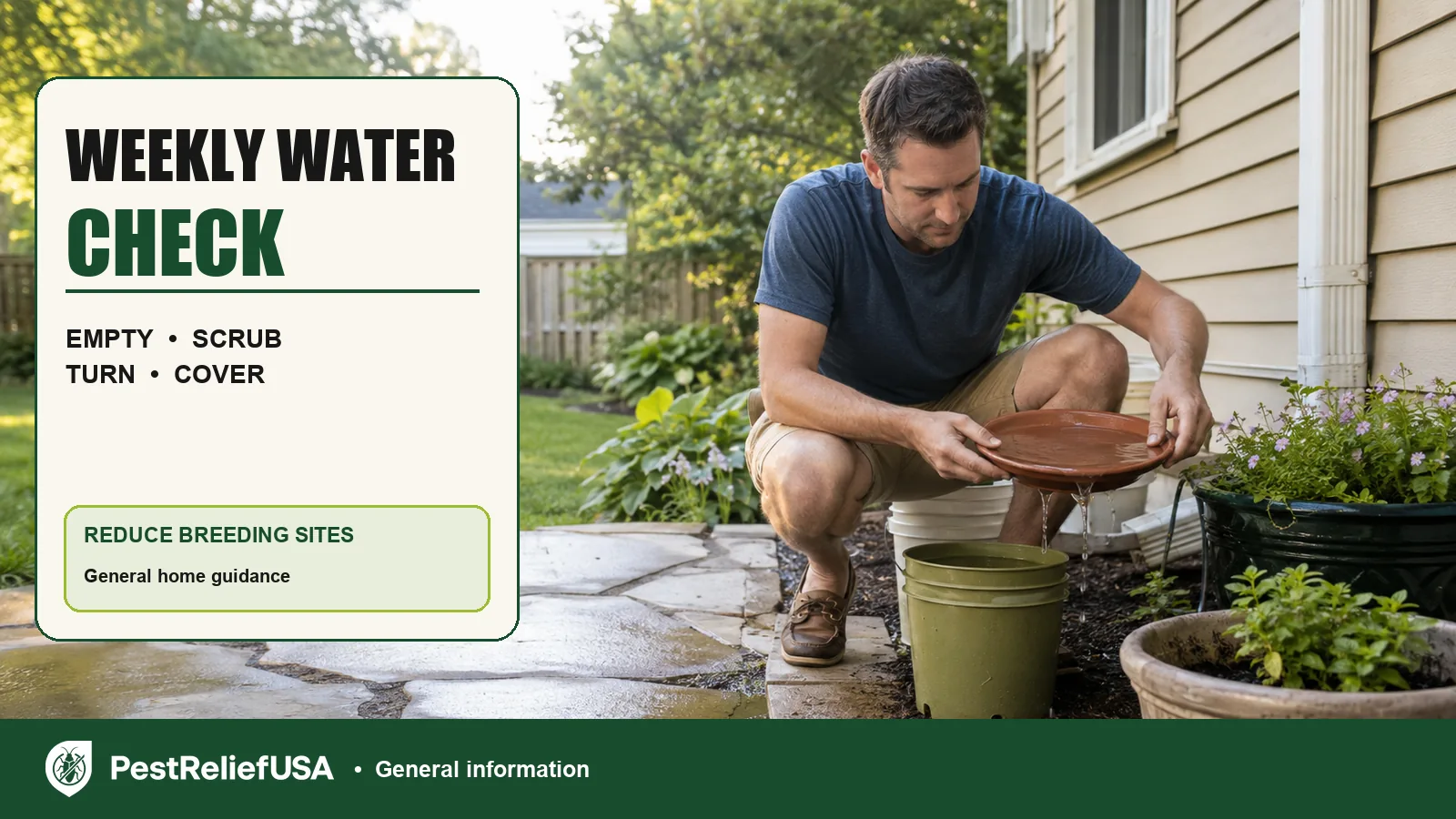
Mosquito control at home starts with a simple weekly routine: walk around the property, find anything holding water, then empty and scrub it, turn it over, cover it tightly, or discard it. Repair damaged window and door screens, keep exterior doors closed, and use an EPA-registered insect repellent as directed when mosquito exposure is likely. These steps can reduce breeding opportunities and bites, but no home checklist can guarantee a mosquito-free property.
Mosquito activity varies with weather, season, species, drainage, vegetation, and conditions beyond one property line. That is why the most useful household plan combines repeatable source reduction with exclusion, personal protection, and local guidance when the problem is larger than a homeowner can reasonably address. PestReliefUSA provides general information and a referral request path; it does not inspect properties, identify mosquito species, apply treatments, or guarantee provider availability.
A five-step mosquito control checklist for home
- Inspect once a week. Check the yard, porch, garage, and indoor containers after rain, irrigation, or routine watering.
- Remove water at the source. Empty and scrub, turn over, cover, or throw away items that collect water.
- Block entry. Repair window and door screens, close gaps around them, and avoid leaving exterior or garage doors propped open.
- Reduce bite exposure. Follow CDC guidance for clothing and use an EPA-registered repellent according to its label.
- Document persistent conditions. Note where water returns, when mosquitoes are most active, and whether the source may extend beyond your property.
This mosquito-specific routine complements a broader home pest-prevention checklist. The difference is focus: here, every step is tied to water, mosquito entry points, bite exposure, or evidence that helps you decide what to discuss next.
Why a weekly standing-water check matters
Mosquitoes lay eggs in or near water, and their immature stages depend on water. A container does not have to look like a pond to deserve attention. A flowerpot saucer, folded tarp, toy, clogged drainage point, or small depression in outdoor equipment may hold enough water to become relevant.
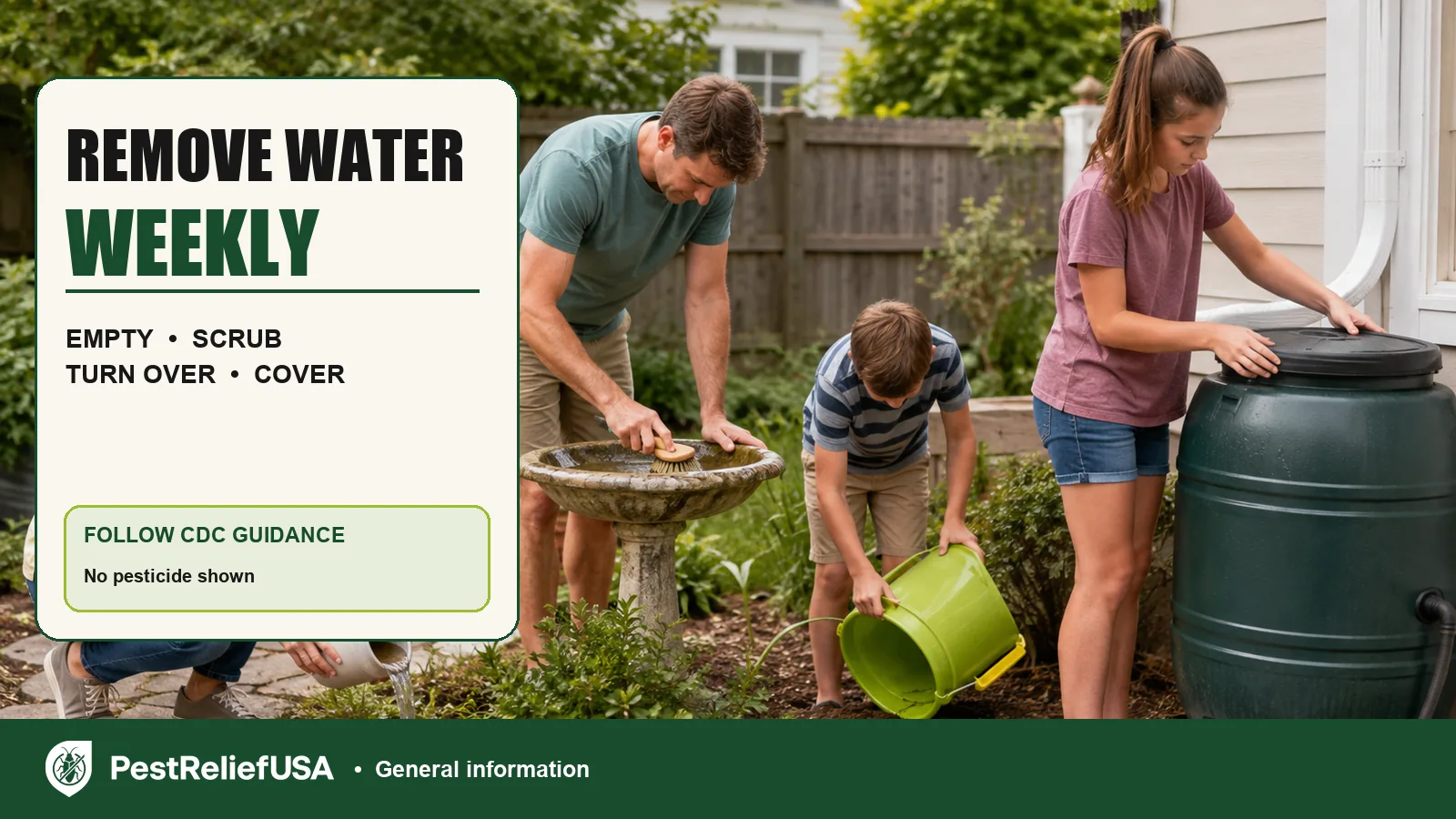
The CDC recommends checking water-holding items once a week and using a practical sequence: empty and scrub them, turn them over, cover them, or throw them out. The agency applies the same empty-and-scrub guidance indoors to help remove mosquito eggs and larvae from items such as vases and flowerpot saucers.
A weekly rhythm is easier to maintain than a one-time cleanup. Tie it to a predictable household task—trash day, lawn care, or weekend watering—then repeat it after heavy rain or a storm. In warm or wet conditions, the same locations may refill quickly, so a single inspection should not be treated as permanent control.
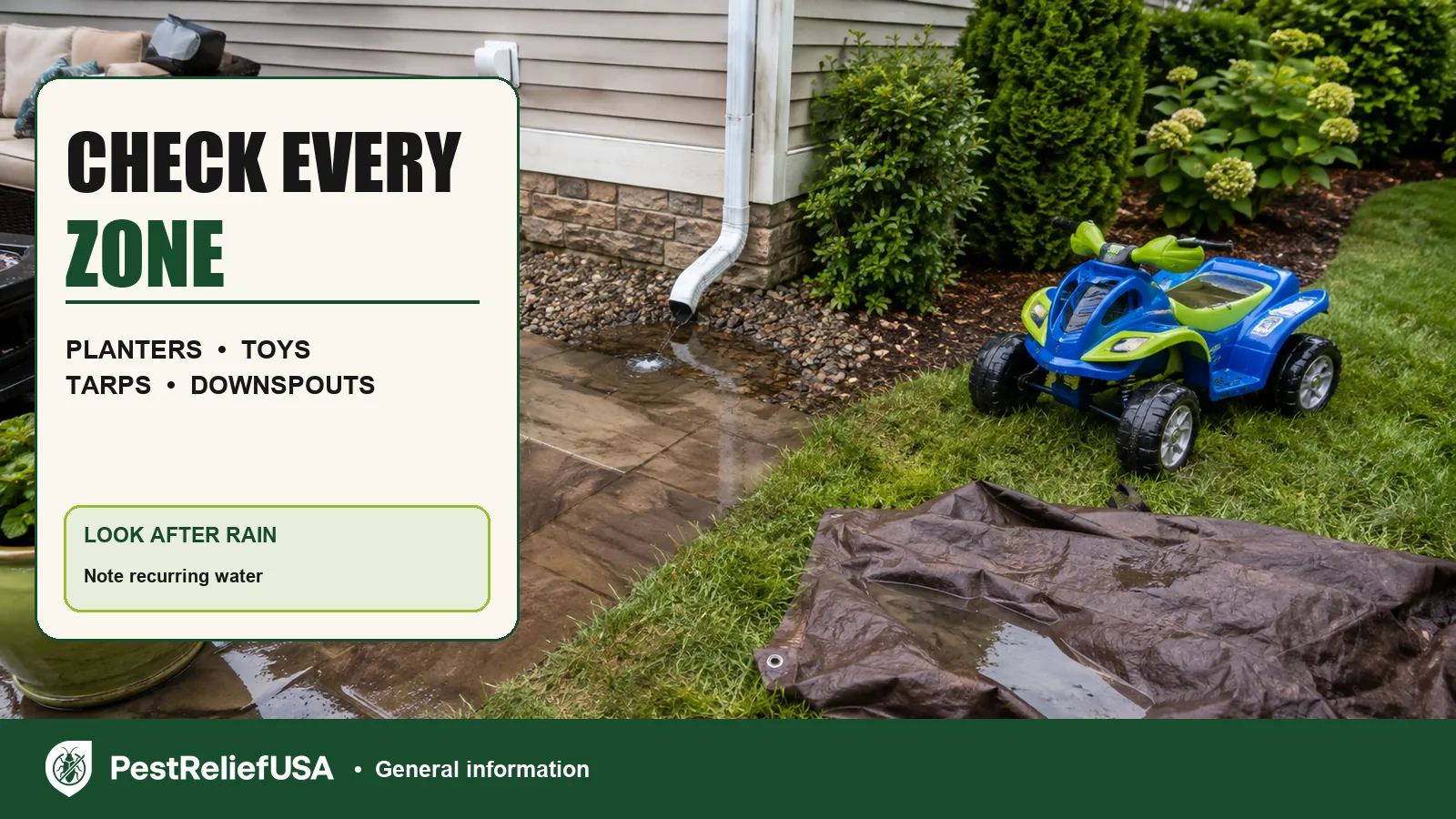
Inspect the property zone by zone
A systematic route helps prevent small containers from being overlooked. Start at the front entrance and work around the house in the same direction each week. Photograph recurring drainage or water-storage issues if you may need to discuss them with a property manager, local mosquito-control program, or independent provider.
Patios, decks, and play areas
- Empty water from buckets, watering cans, toys, wagons, and unused containers.
- Turn over portable pools and play items when they are not in use.
- Check tarps, furniture covers, and folded outdoor fabric for low spots that hold rainwater.
- Look beneath patio furniture and storage racks, where containers may be shaded and easy to miss.
Planters, birdbaths, and decorative features
- Empty and scrub flowerpot saucers and other removable plant containers.
- Refresh and clean birdbaths as part of the weekly routine.
- Check decorative pots, fountains, and ornaments for hidden cavities that retain water.
- Do not assume moving water, chlorination, or a product is adequate unless the feature is maintained according to its specific instructions.
Gutters, downspouts, and drainage points
Observe whether gutters drain after rain and whether downspouts discharge into a low spot or open container. Leaves and debris can contribute to standing water, but climbing onto a roof or working from an unsafe ladder is not a reasonable extension of this checklist. Document inaccessible conditions and use an appropriate maintenance professional when needed.
Trash, recycling, tires, and stored equipment
Keep trash and recycling containers covered where practical, and inspect rims or recessed lids after rain. Store tires and equipment so they cannot collect water. If an item has no current use and repeatedly fills, removing it may be more reliable than remembering to drain it every week.
Property edges and shared areas
Look for water along fences, alleys, shared courtyards, vacant lots, storm drains, and neighboring property without entering land you do not control. A household can correct its own containers, but it cannot manage every source in the surrounding area. The CDC describes mosquito control as a community as well as household effort, so persistent shared conditions may be appropriate to report to a property manager or local mosquito-control program where one exists.
What to do with water that must remain
Some water cannot simply be discarded. Rain barrels, cisterns, ornamental water features, drainage structures, and certain property systems may need to stay in place. The CDC recommends tightly covering water-storage containers so mosquitoes cannot enter. Where a lid is not possible, CDC guidance describes using mesh with openings smaller than an adult mosquito.
If standing water cannot be emptied, covered, or removed, do not improvise a pesticide mixture or assume one product fits every situation. CDC guidance discusses larvicides for certain bodies of water that will not be used for drinking and cannot be covered or dumped out. The site, water use, local conditions, state rules, and product label all matter. Read and follow the entire label, and consult a local mosquito-control program or independent provider if you are uncertain.
Never add a pesticide to drinking water or another site unless that exact use appears on the label. More product is not better, and a household article cannot determine whether a particular product or application is appropriate for your property.
Keep mosquitoes from entering the home
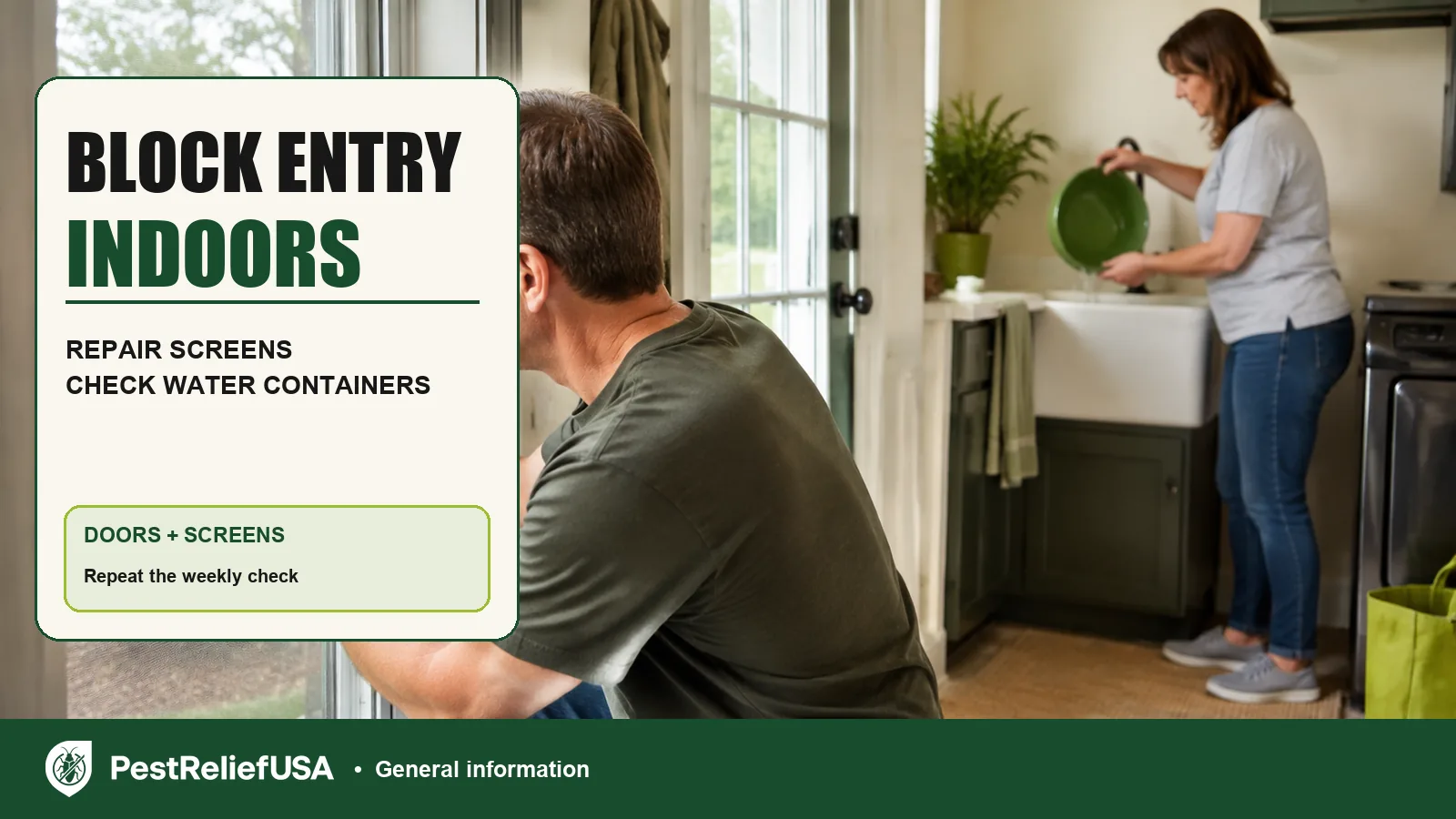
Source reduction outdoors is only one part of mosquito control at home. The CDC also recommends installing or repairing window and door screens, keeping exterior doors—including garage doors—closed, and using air conditioning when available.
Inspect screens in good daylight. Look for tears, loose edges, gaps at the frame, and doors that do not close fully. A small repair may improve exclusion, but screen condition does not explain all indoor mosquito activity. People and pets moving through doors, attached garages, and water-holding items indoors can also contribute.
Check indoor water-holding items
- Empty and scrub vases and flowerpot saucers as part of the weekly check.
- Look at utility areas, laundry spaces, and other humid locations for containers holding water.
- Keep doors closed when they are not actively in use.
- If mosquitoes persist indoors after source reduction and screen repairs, document where and when they appear before considering additional options.
Manage yard conditions without expecting a zero-mosquito result
Adult mosquitoes may rest in shaded, humid areas. Routine yard maintenance can make inspection easier and may reduce some resting conditions, but trimming vegetation is not a stand-alone guarantee. Focus first on correct drainage, water-holding containers, screens, and repeatable observation rather than trying to make every part of a landscape dry or bare.
Record patterns for two or three weeks: the time of day activity is noticeable, where people are being bitten, recent rain or irrigation, and any water that returns after being emptied. This is more useful than guessing the mosquito species or assuming the nearest visible container is the only source.
Seasonal timing and mosquito-control capabilities vary across the United States. Rainfall, temperature, irrigation, drainage, and local mosquito populations can change what a household observes, so avoid treating one regional pattern as a nationwide rule. Use the seasonal pest-prevention guide for a broader maintenance rhythm, then adapt the mosquito check to current local weather and public-health guidance.
Reduce mosquito bites while you address the source
Removing standing water can reduce breeding opportunities, but it does not provide personal protection from mosquitoes already present or arriving from nearby areas. The CDC recommends EPA-registered insect repellents for protection against mosquito bites. The EPA repellent search tool can help compare registered skin-applied products by pest, active ingredient, and expected protection time. The EPA notes that tool results are informational and do not endorse a product.
- Read and follow the product label, including age restrictions and reapplication directions.
- Apply sunscreen first and insect repellent second when using both, as directed by CDC.
- Wear loose-fitting long-sleeved shirts and long pants when practical.
- Do not apply permethrin products directly to skin; use any treated clothing or gear only as its label directs.
- Use mosquito netting over strollers or baby carriers when appropriate, keeping the netting secure and away from the child’s face.
Repellents reduce bite exposure; they do not remove breeding sites. Likewise, a yard treatment does not replace weekly source reduction or screen repair. A layered plan is more realistic than relying on a single product.
For readers asking how to reduce mosquitoes around your home, the practical answer is to combine standing water mosquito prevention with entry control and bite protection. Each layer addresses a different part of the problem, and none should be presented as proof that all mosquitoes or all sources are gone.
When local or independent-provider input may help
Consider contacting a local mosquito-control program, property manager, or independent provider when water repeatedly returns from a drainage or structural issue, the suspected source is inaccessible, mosquitoes remain numerous despite consistent source reduction, or public-health officials have issued local guidance.
Before a conversation, gather useful context: recent weather, recurring water locations, photographs taken safely, indoor versus outdoor activity, screen condition, and the dates of your weekly checks. This information does not identify a species or prove where every mosquito originated, but it can make the next discussion more specific.
For general information about provider-controlled options, review the mosquito control information page. PestReliefUSA does not inspect, identify, spray, treat, quote, schedule, or guarantee availability. Independent providers decide availability, findings, recommendations, scope, treatment, pricing, timing, follow-up, warranty, and contract terms.
Frequently asked questions
How often should I check for standing water?
The CDC recommends a weekly check. Repeat it after heavy rain, irrigation, or a storm when containers and low spots may refill sooner.
Is pouring out standing water enough?
Not always. CDC guidance says to empty and scrub, turn over, cover, or discard water-holding items. Scrubbing removable containers helps address eggs that may remain attached to the inside surface.
Can a very small amount of water attract mosquitoes?
Small containers and shallow pockets of water can matter. Check flowerpot saucers, toys, tarps, recessed lids, and other items that may not look like obvious breeding sites.
Will removing standing water eliminate every mosquito?
No. It can reduce breeding opportunities on the property, but mosquitoes may come from nearby sources and activity changes with weather and local conditions. Combine source reduction with screens, bite prevention, and local guidance when needed.
Make the weekly check easy to repeat
Choose one day, follow the same route, and keep a short note of recurring problems. Empty and scrub, turn over, cover, or discard water-holding items; repair screens; protect against bites; and escalate drainage or community issues that are outside a homeowner’s safe control.
If you want to share property details and explore possible next steps, use the PestReliefUSA request path. Submitting information does not guarantee a provider match or service. Any independent provider decides whether service is available and determines all findings, recommendations, scope, treatment, price, schedule, follow-up, warranty, and contract terms.
Sources and editorial review
- CDC: Mosquito Control at Home
- CDC: Preventing Mosquito Bites
- CDC: What Mosquito Control Programs Do
- EPA: Find the Repellent That Is Right for You
This article is general information for U.S. homeowners and renters. It was reviewed against current CDC and EPA guidance for source accuracy, regional caveats, pesticide-label boundaries, and PestReliefUSA’s information-and-referral model. It does not report a property inspection, species identification, customer case, treatment result, or medical diagnosis.