
Signs of a cockroach infestation can include repeated sightings, dark droppings or smears, egg cases, cast skins, captures in monitoring traps, dead insects, localized odor, and contaminated or damaged food packaging. The most reliable approach is to document several clues together. One sighting or mark cannot establish the species, population size, source, duration, or treatment need.
This guide explains how to tell if you have cockroaches by checking accessible areas and recording patterns without trying to diagnose the problem from a single photo. PestReliefUSA is an independent information and referral resource; it does not inspect properties, identify specimens, recommend property-specific treatment, apply pesticides, quote, schedule, or guarantee availability. See how the PestReliefUSA information and referral process works.
Quick Answer: Signs of a Cockroach Infestation
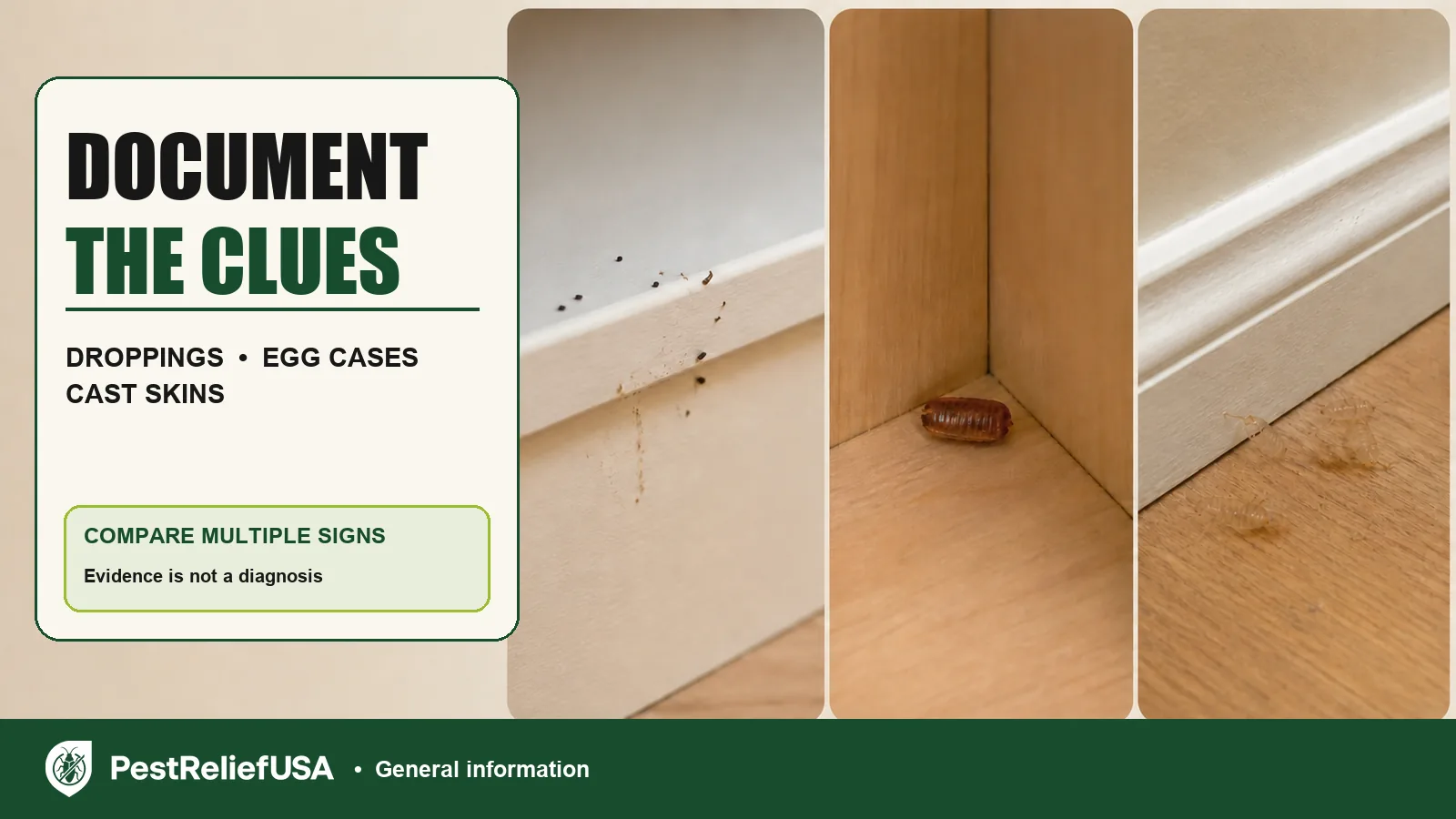
Common cockroach infestation signs include repeated live or dead sightings, droppings or dark fecal spots, egg cases called oothecae, cast skins, monitoring-trap captures, localized odor, and food or packaging contamination. UC Statewide IPM identifies fecal matter, cast skins, egg cases, and live or dead cockroaches as evidence that can guide closer inspection and trap placement.
No individual clue confirms an infestation or tells you which response is appropriate. The U.S. Environmental Protection Agency’s integrated pest management guidance places monitoring and correct identification before control decisions. Look for a repeated pattern across several clues, locations, or monitoring dates.
8 Possible Cockroach Infestation Signs to Document
1. Repeated Live or Dead Sightings
Most cockroaches hide during the day and become active at night. Both University of Minnesota Extension and UC IPM describe this mainly nocturnal pattern. A single nighttime sighting may be an occasional invader, especially where outdoor species occur. Repeated sightings in one room or across several rooms are more useful evidence than one encounter.
Because nighttime activity is typical, a daytime sighting can justify checking nearby accessible areas for other evidence, but it does not automatically prove a large or severe infestation. Record the time and exact location, then look for droppings, egg cases, cast skins, or trap captures before drawing a conclusion.
2. Droppings and Dark Fecal Spots
Cockroach droppings vary with species and body size. UC IPM describes fecal matter at monitoring sites as dark spots or smears. Smaller cockroaches may leave fine specks, while larger species may leave more pellet-like material. Old or dried deposits may also look different from fresh material.
Droppings alone are not a reliable species or severity test. Dirt, food debris, insect frass, and small rodent material can look similar in dim light. Photograph the material in place with a coin or ruler for scale, note whether it occurs along a wall or near an appliance, and avoid identifying it from appearance alone.
3. Egg Cases, or Oothecae
An ootheca is a cockroach egg case. Its size, color, shape, and handling by the female vary by species. UC IPM explains that German cockroaches carry the egg case for most of its incubation period, while other covered species deposit cases earlier in protected locations. Minnesota Extension likewise notes that species differences matter when examining egg cases.
A case attached to an insect and a case deposited beneath furniture or near an appliance may therefore represent different species or stages. Photograph it before moving it, record where it was found, and let a qualified person who can examine the evidence determine what it is.
4. Cast Skins
Young cockroaches molt as they develop, leaving pale, hollow cast skins. UC IPM lists cast skins with fecal spots, egg cases, and live or dead cockroaches as evidence that can help identify likely harborages or monitoring locations.
One skin without context is a weak clue. Several skins in the same cabinet, appliance edge, or protected junction become more meaningful when they occur with dark spots, an egg case, or repeated sightings. Document the cluster and location instead of treating the skin alone as proof.
5. Monitoring-Trap Captures
Sticky traps, or glue boards, are monitoring tools rather than treatment guarantees. UC IPM and Minnesota Extension recommend placing them tight against accessible edges where walls meet floors and near likely activity, such as cupboards, refrigerators, stoves, or sinks. UC IPM also recommends numbering traps and checking them regularly so results can be compared by location.
Keep traps away from places where children or pets may contact them, and do not move fixed appliances or enter unsafe spaces merely to place one. Several captures over multiple checks, especially at one location, provide a stronger activity pattern than a single capture. Monitoring does not by itself select or complete a treatment.
6. Dead Cockroaches or Body Parts
A dead cockroach is still useful evidence. UC IPM includes live and dead cockroaches among the observations that can guide inspection and monitoring. A specimen may preserve body shape, antennae, wings, and other features better than a brief sighting of an insect that quickly scattered.
Photograph the specimen in place and note the room, nearby plumbing or appliance, and date. If retaining it is practical, place it in a securely closed container without direct contact. A detached wing or leg is less conclusive than a complete specimen, so record fragments as possible evidence rather than a diagnosis.
7. Localized Musty or Oily Odor
A persistent localized odor can accompany cockroach activity in some settings. Minnesota Extension notes that cockroaches can produce odors and stain surfaces, while UC IPM specifically notes unpleasant odors associated with German cockroaches. Odor descriptions are subjective and can vary by species, location, and the person noticing them.
Mold, plumbing problems, spoiled food, and other sources can produce similar smells. Treat odor as a supporting clue only when it occurs with physical evidence in the same confined area, such as fecal spots, cast skins, egg cases, or repeated trap captures.
8. Food or Package Contamination and Damage
Stains, smears, damage to paper or cardboard packaging, or insects and egg cases found with stored goods are worth documenting. Minnesota Extension advises checking bags, boxes, and luggage for cockroaches or egg capsules and notes that cockroaches can stain surfaces and damage paper products. UC IPM also notes food and utensil contamination by German cockroaches.
Other pests can damage packaging, so one torn box does not identify the cause. Check for accompanying dark spots, an egg case, cast skins, or a specimen, and photograph both a wide view of the storage area and a close view of the affected package.
Where Cockroach Evidence May Appear
Kitchens and Appliances
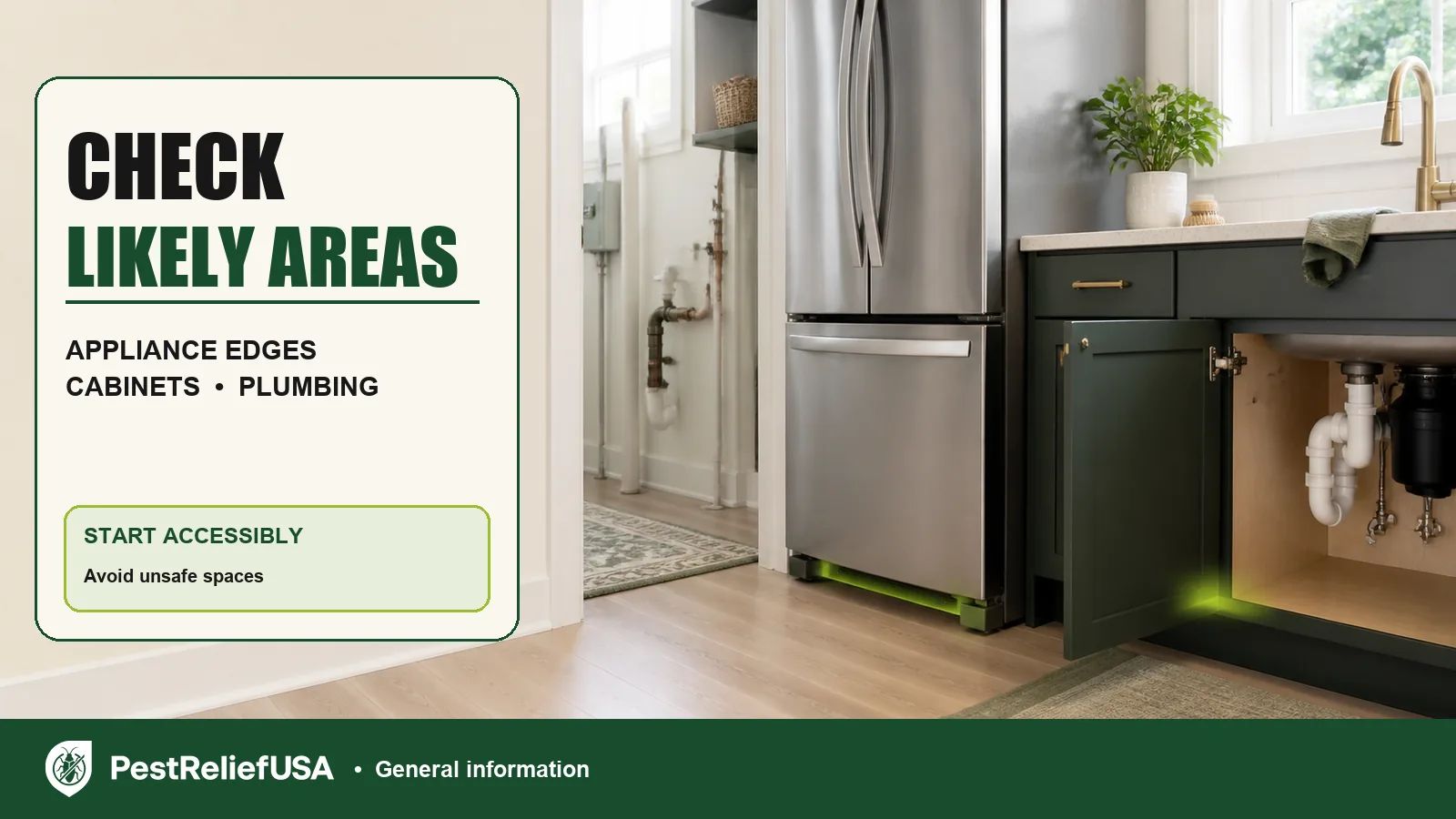
Kitchens combine food, moisture, warmth, and narrow hiding spaces. UC IPM recommends inspecting cupboards and accessible edges behind large appliances, while Minnesota Extension lists cupboards and areas around refrigerators, stoves, and sinks as useful monitoring locations. Check drawer tracks, cabinet corners, kickplates, and visible wall-floor junctions without dismantling fixtures.
Bathrooms and Plumbing Areas
Warm, moist areas near water sources can support activity. Look around accessible sink-cabinet edges, plumbing penetrations, and areas where leaks or condensation occur. Moisture alone is not proof of cockroaches, but it can help prioritize where to look when another clue has already been found.
Utility and Storage Areas
Water heaters, laundry areas, basements, crawl-space entrances, and stored cardboard can provide dark or protected spaces. UC IPM recommends flashlight inspection around water heaters and other dark locations and identifies paper, boxes, and clutter as hiding places. Stay within safely accessible areas; do not enter a confined or hazardous space for this check.
Multi-Unit and Shared-Wall Buildings
In apartments and other multi-unit buildings, plumbing and electrical penetrations can provide movement routes between parts of a building. Minnesota Extension describes multi-unit control as a building-level challenge and recommends restricting movement at plumbing entries. Evidence inside one unit does not establish where activity began. Document the location and contact building management or a landlord when appropriate; requirements and responsibilities vary by jurisdiction and lease.
Cockroach activity can occur in well-maintained homes and shared buildings. Food, water, shelter, access points, neighboring activity, and items brought indoors can all matter. Evidence is not a moral judgment or automatic proof of neglect.
What One Sighting Can and Cannot Tell You
A single observation is a starting point. It generally cannot establish:
- Species. Several cockroach species occur in and around U.S. homes, and their regional distribution differs. UC IPM and Minnesota Extension both emphasize correct identification before management decisions.
- Population size. One visible insect does not reveal how many are present or whether the sighting was an occasional outdoor invader.
- Source. A cockroach may have entered from outdoors, arrived with an item, or moved through another part of a building.
- Duration. Old droppings, egg cases, and cast skins can remain after the activity that produced them.
- Severity or treatment need. EPA IPM guidance supports monitoring, identification, and thresholds rather than treating every observation as the same problem.
Cockroach Evidence Versus Common Look-Alikes
Beetles versus cockroaches: Adult cockroaches are broad and flattened with long antennae. UC IPM notes that cockroaches have membranous wings rather than the thick, hardened forewings of adult beetles. A partial view may still be misleading.
Crickets versus cockroaches: Minnesota Extension lists crickets among insects commonly mistaken for cockroaches. If the insect is incomplete, blurred, or seen only briefly, retain a clear photo or safely contained specimen instead of relying on one body feature.
Other insect material: Frass, dark debris, or shed material from other insects may resemble cockroach evidence. The combination of material type, exact location, and repeated observations is more useful than any isolated speck.
Rodent material versus cockroach droppings: Size and shape can overlap, especially when material is broken or viewed without scale. Do not identify it from one photo. Record the pattern and consult the broader guide to common signs of a pest infestation when the evidence does not clearly point to one pest.
How to Document Possible Activity
Useful documentation preserves context. These low-risk steps can help:
- Take wide and close photographs. Show the room or cabinet first, then the detail with a coin or ruler for scale.
- Record location and date. Note the room, cabinet, appliance, plumbing fixture, or exterior wall nearby.
- Track repetition. Record whether a clue appeared once or recurred over several checks.
- Inspect safely with light. UC IPM recommends a flashlight for cracks, areas beneath counters, around water heaters, and other dark locations; a small mirror can help with hard-to-see accessible areas.
- Label monitoring traps. Number traps by location and record counts over time. Follow the trap manufacturer’s directions and keep traps away from children and pets.
- Keep a specimen closed. If practical, retain a dead specimen or egg case in a sealed container for an Extension specialist or qualified independent provider.

Conditions Worth Correcting
Cockroaches need access to food, water, and shelter. The EPA’s smart pest-control guidance recommends reducing these resources as part of an integrated approach. For cockroach context, that means cleaning accessible crumbs and spills, storing food securely, correcting leaks or condensation, and reducing unused cardboard or clutter.
These steps can make a space less hospitable, but they do not identify the species or replace an assessment of continuing activity. The site’s whole-home pest-prevention guide covers broader maintenance without duplicating it here.
Frequently Asked Questions
Does seeing one cockroach mean I have an infestation?
No. One sighting does not confirm an established infestation, but it is a reason to record where and when it occurred and check for other cockroach infestation signs. Repeated sightings, several evidence types, or consistent monitoring captures provide more useful context.
Can cockroach activity affect health?
Cockroach saliva, feces, and cast skins can irritate allergies and asthma in sensitive people, according to Minnesota Extension. This is exposure information, not a diagnosis. A healthcare professional should address symptoms or individual medical concerns.
Are all cockroaches found indoors the same species?
No. Some species live and breed indoors, while outdoor species may occasionally enter a home. Which species are common varies across U.S. regions and climates. Identification matters because implications and management options differ.
What do droppings without a live cockroach mean?
They indicate that some kind of activity may have occurred, but not necessarily when, how much, or which species caused it. Photograph the location and look for fresh changes, egg cases, cast skins, specimens, or monitoring captures before reaching a conclusion.
Can I use sticky traps before asking for help?
Sticky traps can be a low-risk monitoring step when used according to their instructions at accessible wall-floor edges near suspected activity. They help compare locations and patterns; they are not a treatment guarantee and do not determine a property-specific response.
A Practical Next Step
Start with photographs, dates, locations, and repeated observations. If evidence continues or identification remains uncertain, a local Extension resource or qualified independent provider can evaluate what is actually present. For general context before contacting anyone, review PestReliefUSA’s cockroach-control information.
If you want to explore local help options after documenting the evidence, you can submit a request through PestReliefUSA. A request does not guarantee a provider connection or appointment. Independent providers determine availability, identification, findings, recommendations, scope, treatment, scheduling, pricing, follow-up, warranties, and contract terms.