
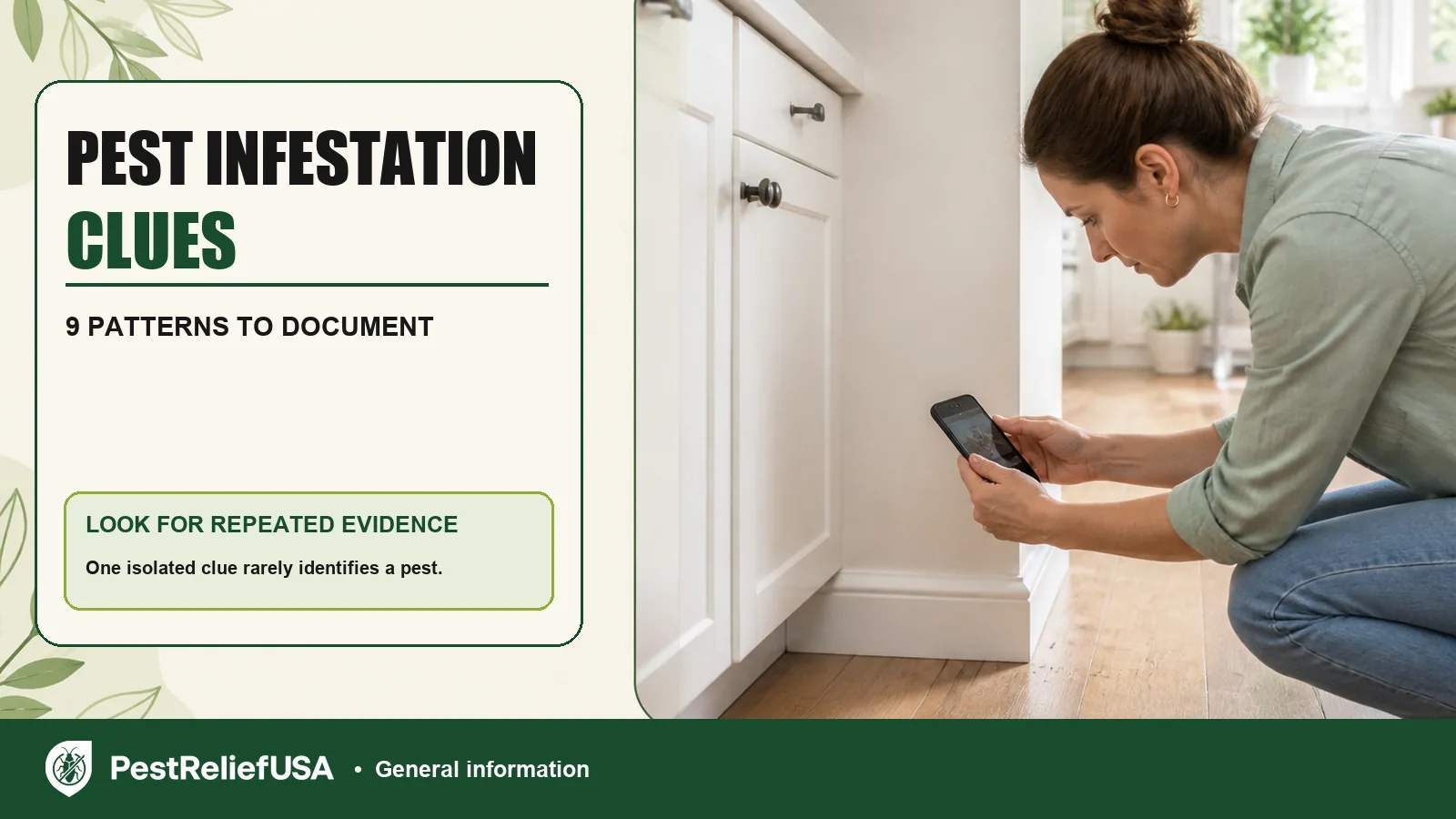
Signs of a pest infestation usually appear as a pattern of evidence, not one isolated insect or mark. Repeated sightings, droppings or shed material, damaged food or building materials, nesting evidence, unusual sounds or odors, and activity around moisture or entry points are all reasons to investigate. The type, location, timing, and recurrence of the evidence matter more than any single clue.
This article is a cross-pest triage guide for U.S. homeowners. It does not replace species-specific identification or an inspection. PestReliefUSA provides general information and may help users connect with independent providers; those providers determine availability, identification, findings, recommendations, scope, treatment, scheduling, pricing, follow-up, warranty, and contract terms.
Quick answer: What are common signs of pest infestation?
Common signs include repeated live or dead pest sightings, droppings or frass-like material, shed skins or egg cases, gnawed or stained materials, damaged food packages, nests or webbing, scratching sounds, unusual odors, and activity concentrated near food, water, shelter, or entry gaps. The EPA’s Integrated Pest Management principles emphasize monitoring and accurate identification before deciding whether control is needed.
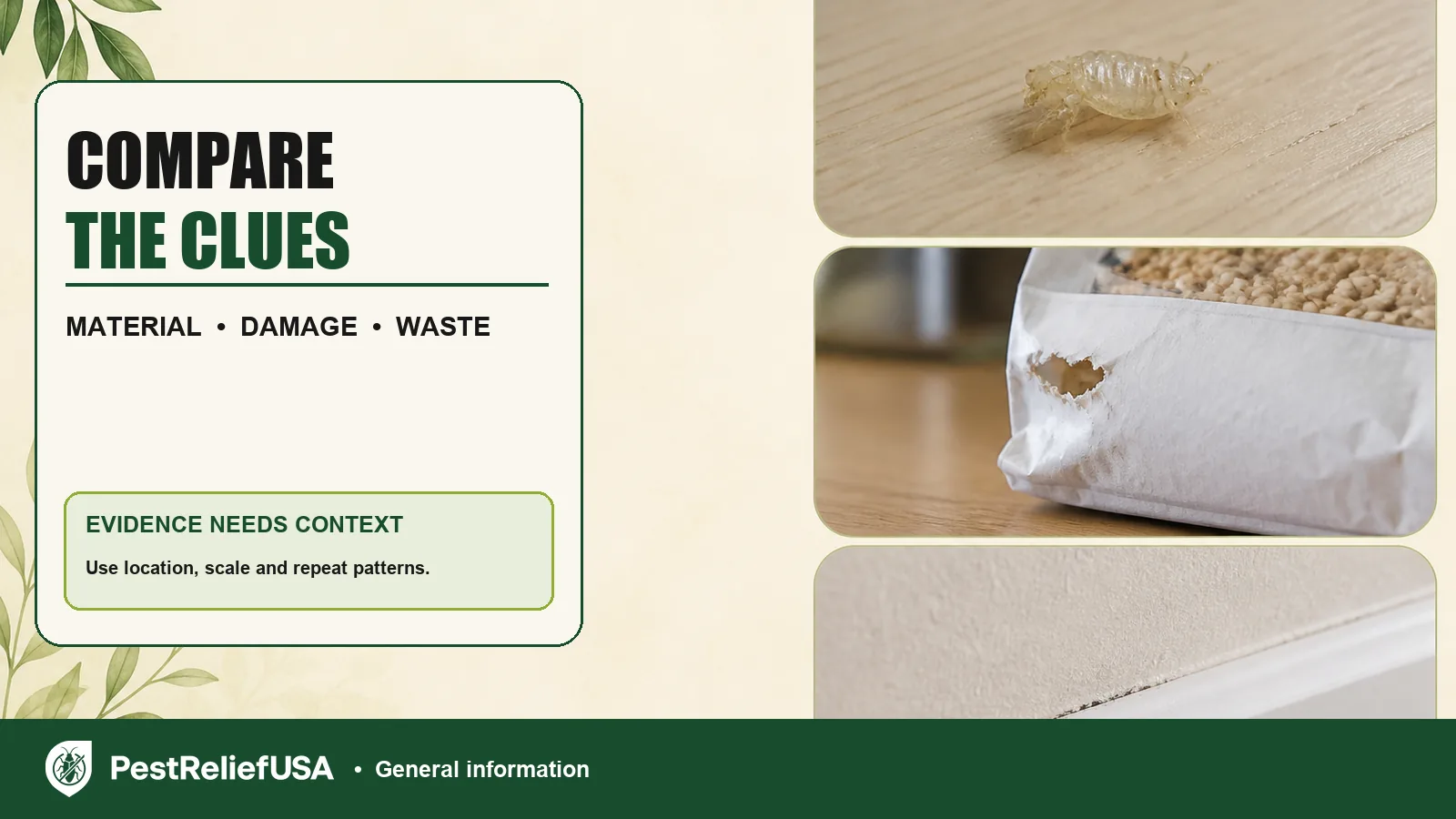
1. Repeated sightings in the same area
One insect entering through an open door is different from repeated activity in the same cabinet, bathroom, bed area, window, basement, or exterior wall. Record the date, time, number seen, and exact location. Daytime activity can be meaningful for some nocturnal pests, but it is not a universal measure of severity.
Capture a clear photo when it can be done safely. Do not crush or handle an unknown arthropod with bare hands, and do not assume every insect indoors requires treatment. Many insects are occasional invaders or beneficial species that entered accidentally.
2. Droppings, pellets, frass, or other waste-like material
Small pellets, specks, sawdust-like debris, or staining can point to activity, but similar material may come from different pests—or from ordinary household debris. Location and surrounding evidence are essential. Rodent droppings require specific public-health precautions; homeowners should review the detailed rodent activity guide and current CDC cleanup instructions rather than sweeping or vacuuming dry material.
Termite pellets and shelter tubes also have specific limits. The broader signs of termites guide explains why visible evidence cannot establish termite type, current activity, or structural extent by itself.
3. Shed skins, wings, egg cases, or insect parts
Cast skins, loose wings, egg cases, or insect fragments can help narrow identification. Photograph the item where it was found, then include a close view with scale. Do not identify a pest solely from a blurry image or from color alone; life stage, lighting, damage, and camera processing can change appearance.
Loose wings near a window do not automatically mean termites, and a skin reaction does not prove bed bugs. Use the surrounding evidence and a species-specific resource. If bed bugs are suspected, the bed bug first-steps guide explains how to document and contain evidence without spreading belongings.
4. Damage to food, fabrics, wood, or wiring
Torn packaging, gnaw marks, small holes, fabric damage, wood changes, and damaged wiring are all investigation triggers. They are not interchangeable signs. Pantry pests, rodents, clothes moths, carpet beetles, termites, and other organisms leave different evidence, while moisture, abrasion, pets, or building wear can create look-alikes.
Do not handle exposed wiring or cut into a wall to chase evidence. Keep people and pets away from electrical or structural hazards and involve the appropriate qualified professional when a building system may be affected.
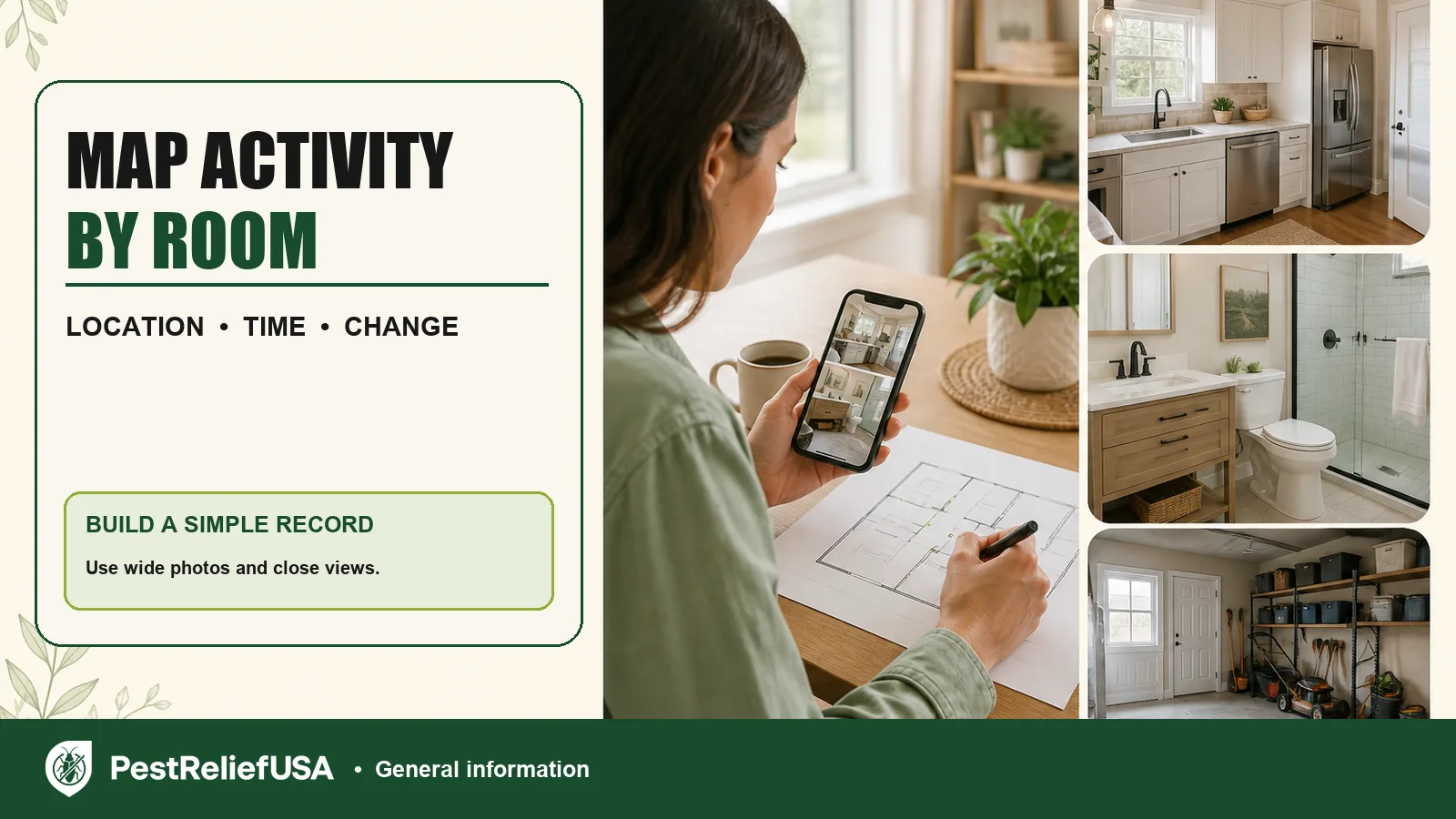
5. Nesting material, webbing, trails, or concentrated debris
Shredded paper or insulation, webbing in stored food, ant trails, concentrated insect parts, or repeated debris beneath one opening can reveal a route or harborage. Ordinary cobwebs, lint, renovation dust, and stored materials can look similar, so document the pattern before cleaning.
Avoid pulling apart a suspected nest, entering an unsafe attic or crawlspace, or disturbing contaminated insulation. Accessible photographs and notes are usually more useful than invasive DIY exploration.
6. Scratching, tapping, buzzing, or movement sounds
Sounds in walls, ceilings, cabinets, attics, or vents can focus an inspection area, but sound alone rarely identifies the source. Rodents, birds, squirrels, insects, ducts, pipes, and ordinary building movement can overlap. Record when the sound occurs, how long it lasts, and whether it follows the same route.
7. Persistent or unusual odors
Musty, stale, oily, sweet, or decomposition-like odors may accompany pest activity, contamination, moisture, drains, mold, stored products, or a dead animal. Odor is a location clue, not a diagnosis. Avoid opening walls or applying fragrances and chemicals merely to mask the smell; identify the source and any building or sanitation issue first.
8. Bites, itching, or skin reactions
Skin reactions should not be used to identify a household pest. Different insects and non-pest conditions can produce similar marks, and people may react differently. Seek medical guidance for concerning symptoms. For property investigation, rely on physical evidence such as specimens, cast skins, fecal spots, harborages, or repeat sightings rather than the appearance of a bite.
9. Activity around food, water, shelter, or openings
Pests often concentrate where resources and access overlap: leaking plumbing, standing water, open food, pet food, overflowing waste, dense storage, damaged screens, door gaps, utility penetrations, and sheltered exterior edges. These conditions do not prove an infestation, but correcting them supports prevention and makes monitoring more informative.
The EPA describes IPM as a sequence of monitoring, identification, prevention, and appropriately selected control—not automatic pesticide use after one sighting. Removing food, water, and shelter and repairing access points can be useful across many pest categories, while the exact response still depends on identification and context.
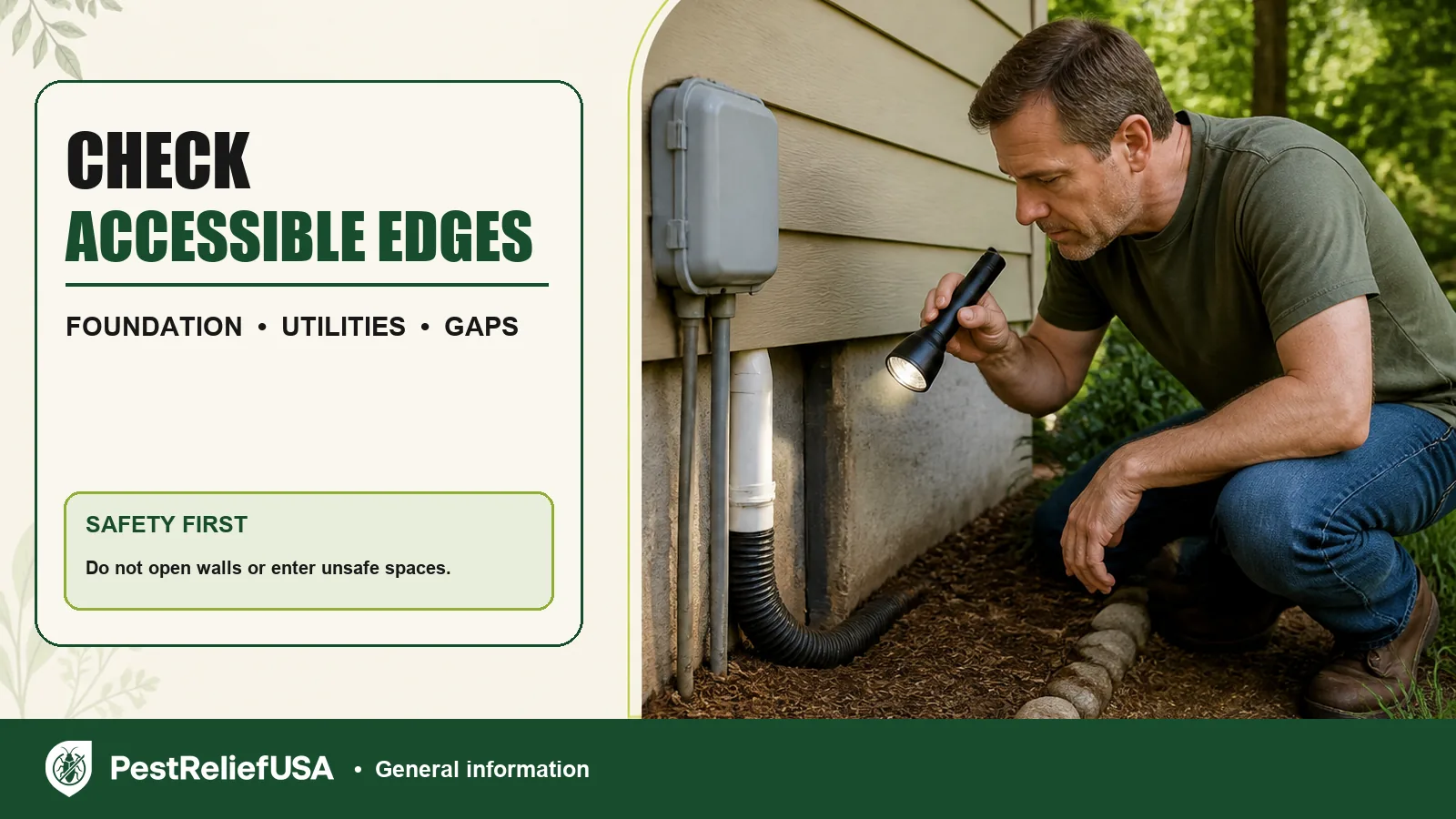
How to document pest evidence without spreading it
- Take a wide photo: Show the room, fixture, or exterior feature.
- Add a close photo: Include scale without touching unknown waste or contamination.
- Record time and recurrence: Note whether evidence returns after safe cleanup.
- Keep categories separate: Store photographs by room and evidence type rather than assigning a species prematurely.
- Avoid moving affected belongings: Movement can spread some pests or erase the location pattern.
When should homeowners seek independent help?
Consider qualified help when evidence persists, identification remains uncertain, contamination is extensive, activity involves wiring or structural materials, access is unsafe, or household conditions make control difficult. Homeowners can review the site’s pest information and referral categories or submit non-urgent property details through Get Help. Provider participation and availability vary.
Frequently asked questions
Does seeing one bug mean there is an infestation?
No. One occasional invader may not indicate an established problem. Record the location and monitor for repeated sightings, life stages, damage, waste, or harborages before drawing a conclusion.
What is the strongest evidence of a pest problem?
Recurring, location-specific evidence is more useful than one isolated clue. Multiple life stages, new waste after safe cleanup, repeated damage, or consistent activity along one route can justify closer investigation.
Can online photos identify a pest?
Photos can narrow possibilities, but image quality, life stage, scale, and regional species variation limit certainty. A physical specimen or property inspection may be needed.
Should homeowners spray immediately after seeing a pest?
Not automatically. EPA IPM guidance prioritizes monitoring and accurate identification so the wrong or unnecessary pesticide is not used. Any pesticide must be used according to its label.
What information should I share with a provider?
Share dated photos, locations, recurrence, accessible entry points, recent property changes, and any safety constraints. The provider determines what additional inspection or response is appropriate.
Bottom line
The clearest signs of pest infestation are repeatable patterns: sightings, waste, shed material, damage, nesting evidence, sounds, odors, and activity around resources or openings. Document before disturbing, use species-specific safety guidance, and let identification—not fear or one ambiguous clue—drive the next step.
Hi, this is a comment.
To get started with moderating, editing, and deleting comments, please visit the Comments screen in the dashboard.
Commenter avatars come from Gravatar.