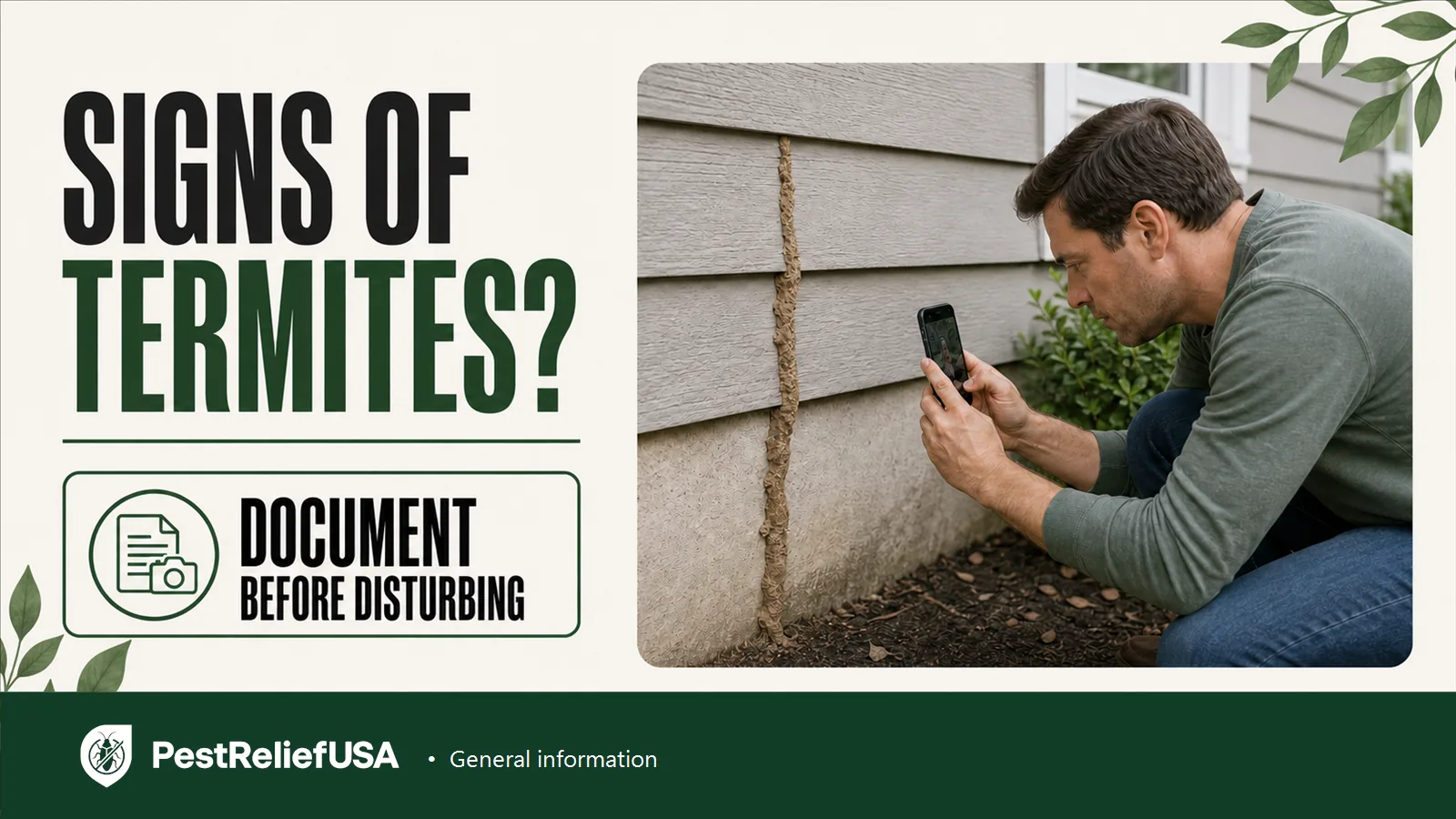
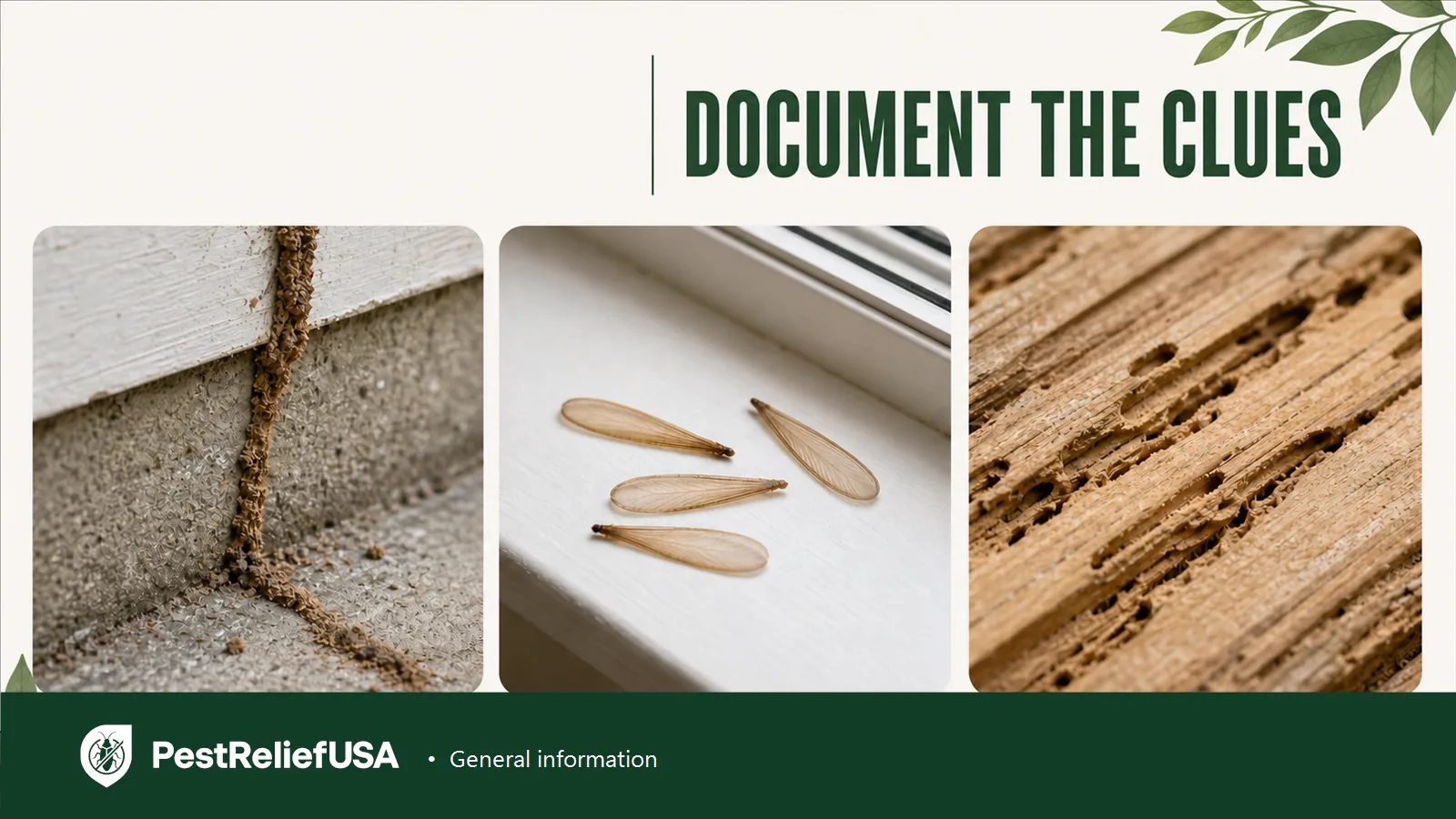
Common signs of termites include mud or shelter tubes, indoor swarmers, piles of discarded wings, hollow or tunneled wood, and drywood termite pellets. These clues justify a closer review, but no single sign can confirm the termite type, whether activity is current, how far it extends, or whether a building component is structurally safe.
Termite activity is often concealed. The U.S. Environmental Protection Agency explains that termites rarely emerge from the soil, mud tubes, or materials through which they are tunneling. Homeowners are therefore more likely to notice a swarm or uncover possible damage during construction than to see worker termites moving in the open.
This guide explains eight possible clues, where evidence may appear, and what to document without damaging or disturbing the area. PestReliefUSA is an independent information and referral resource. It does not inspect properties, identify specimens, diagnose damage, or make property-specific treatment recommendations.
Signs of Termites Homeowners May Notice
The most useful signs of termites are physical evidence that can be photographed or retained: shelter tubes, indoor swarmers, shed wings, changes inside exposed wood, soil-lined galleries, and drywood pellets. So-called early signs of termites may already reflect concealed activity, and visible timing cannot date a colony. Conditions such as leaks, dampness, poor drainage, or wood-to-soil contact may increase risk or help guide an inspection, but they are not proof of termite activity.
Evidence also varies by termite type and location. The EPA describes native subterranean termites as the most common type across most of the United States, while drywood and Formosan termites have more limited distributions. Swarm timing, likely nesting areas, and construction details vary regionally, so a clue should be treated as a reason to investigate rather than as a nationwide diagnostic rule.
8 Possible Termite Clues to Document
1. Mud Tubes or Shelter Tubes
Mud or shelter tubes are narrow, enclosed pathways that subterranean termites build to move across exposed surfaces while retaining moisture and protection. NC State Extension documents tubes on foundation walls, floor joists, subflooring, and in gaps between structural materials in its guidance for eastern subterranean termites.
A tube can be useful evidence even when it looks dry or damaged. NC State notes that termites may abandon or rebuild tubes and that old tube marks can remain visible for years. Photograph its full path and surrounding area, record the location, and leave it intact for an independent provider to assess. Its appearance alone cannot establish whether activity is current.
2. Termite Swarmers Indoors
Winged reproductive termites, called swarmers or alates, may appear near windows, doors, or lights when they leave a mature colony. An indoor swarming event is worth documenting promptly, but it does not by itself establish the species, colony location, extent of activity, or need for a particular treatment.
Termite swarmers are often confused with winged ants. Termites generally have four wings of roughly equal length and relatively straight antennae; ants have longer front wings and bent antennae, according to the EPA. For a focused visual comparison, see termites versus flying ants. Take clear photos and, if it is safe and practical, retain a loose insect in a sealed container without opening walls or disturbing building materials.
3. Discarded Wings
Small piles of shed wings can remain after swarmers have dispersed. Look near windowsills, door frames, light sources, vents, and other places where winged insects may collect. Termite wings are generally similar in length, but a loose wing without the insect body may be difficult for a homeowner to identify confidently.
Photograph the wings where they were found, include a nearby object for scale, and record the date and exact location. If practical, place a few loose wings in a sealed bag or container. Wings show that a winged insect was present; they do not establish whether a termite colony is active in the structure.
4. Hollow, Soft, or Altered Wood
Wood that sounds hollow when lightly tapped or appears soft may warrant closer review. The EPA lists hollow spots in exposed wood as one way termite damage may be discovered, while NC State describes hollow-sounding or easily probed wood among signs associated with eastern subterranean termite feeding.
Do not pry, puncture, or cut finished or structural wood to investigate. Moisture, decay, construction defects, and other insects can also change how wood looks, feels, or sounds. Photograph accessible surfaces and note what you observed without labeling the material as active termite damage.
5. Termite Galleries or Tunneled Wood
If wood is already exposed during ordinary repairs, possible termite galleries may appear as chambers or tunnels within it. Subterranean termite galleries can contain soil or mud-like material, while evidence from other termite types may look different. UC Statewide IPM explains that termite species differ in nesting behavior and in the galleries they form.
Photograph the exposed area before work covers or removes it, including both close and wide views. Do not open additional walls, ceilings, floors, or structural members solely to search for more evidence. The visible portion cannot show the full extent or structural significance of what may be concealed.
6. Drywood Termite Pellets and Kickout Holes
Drywood termites may expel small, hard fecal pellets through openings in infested wood. UC Statewide IPM describes these pellets as having six flattened sides and notes that accumulations below surface openings may be an early clue. This evidence is specific to drywood termites; subterranean termites do not create the same visible pellet piles.
Drywood termites have a regional U.S. distribution, and the UC resource describes California conditions rather than a nationwide pattern. Pellet piles can also persist after earlier activity. Photograph them in place and record any nearby opening, but do not use pellets alone to decide whether activity is current or how far it extends.
7. Surface Changes Around Wood
Blistering paint, slight warping, or a sticking door or window can be a possible clue when other termite evidence is nearby. On their own, these surface changes are weak evidence because humidity, leaks, decay, seasonal wood movement, settling, and installation problems can produce similar effects.
Record when the change appeared and whether a nearby moisture source or recent repair could explain it. Avoid calling a surface change termite damage unless a property-specific assessment supports that conclusion.
8. Evidence Uncovered During Repairs
Possible evidence may become visible when a contractor or homeowner is already performing a repair or renovation. That can include concealed tubes, tunneled wood, soil-like material inside wood, insects, wings, or pellets. Hidden evidence is not automatically new, active, severe, or structurally important.
Pause work only as needed to photograph what is already exposed and record its location. Do not enlarge the opening or remove structural material just to investigate. A pest professional can assess accessible termite evidence, while questions about load-bearing capacity or structural safety require appropriately qualified building or engineering expertise.
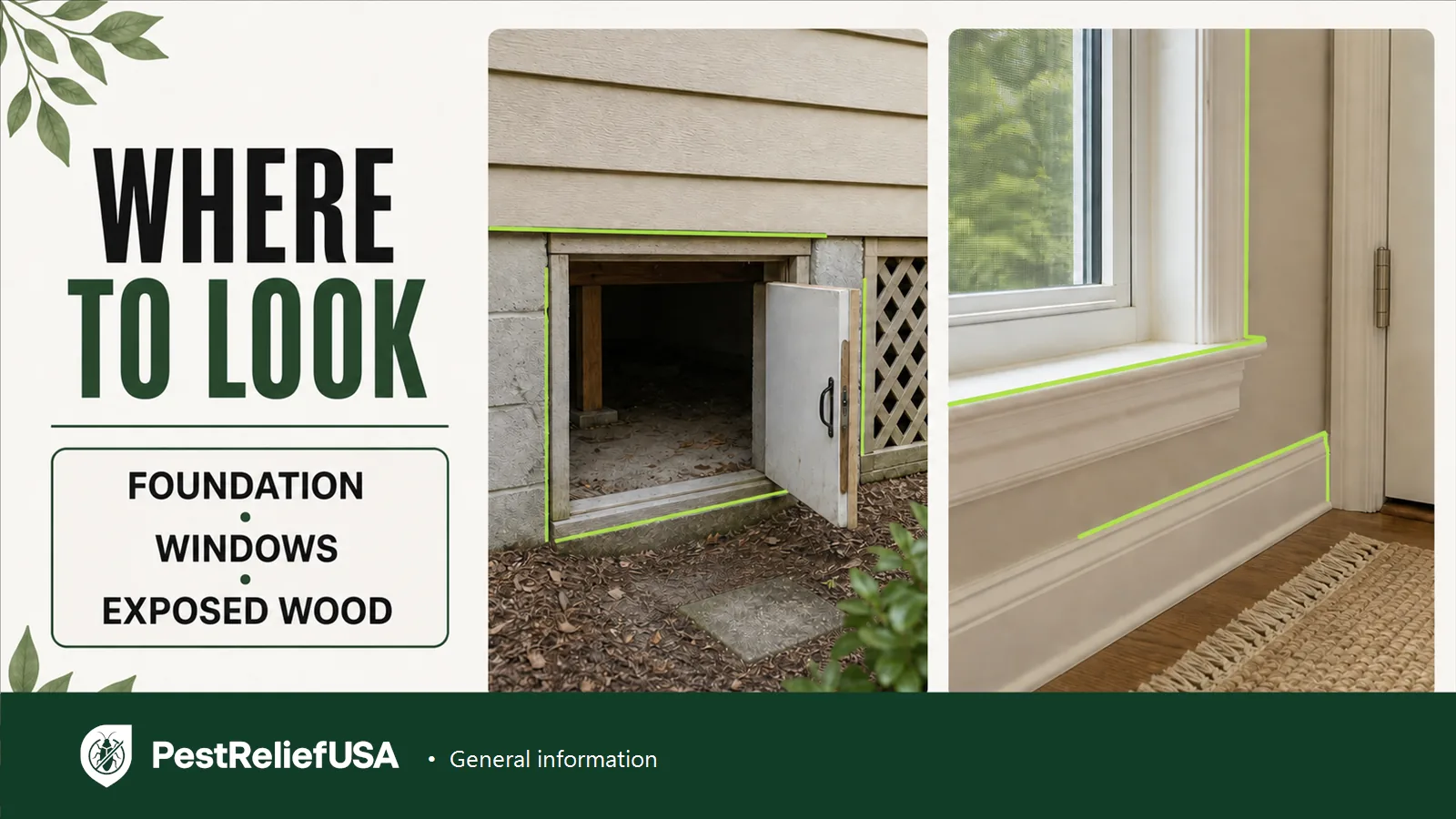
Where Termite Evidence May Appear
Foundation and Crawlspace Areas
For subterranean termites, foundation walls, piers, floor joists, crawlspaces, and places where wood meets or approaches soil are useful areas to observe. NC State’s eastern subterranean termite guidance illustrates shelter tubes on crawlspace supports and describes wood-to-ground contact and excess moisture as conducive conditions. These regional examples may not match every foundation type or climate.
Only view areas that are safely accessible. Do not enter a cramped, flooded, unstable, moldy, or otherwise hazardous crawlspace, and do not disturb insulation, wiring, pipes, or vapor barriers to search for termite evidence.
Windows, Doors, and Light Sources
Swarmers and discarded wings may collect near windows, exterior doors, lamps, and other light sources. Photograph both the insects or wings and the larger area so an inspector can understand whether the evidence was indoors, outdoors, or close to an opening.
Exposed Wood and Wood-to-Soil Contact
Deck posts, porch framing, stairs, siding, stored lumber, and other wood near soil can offer useful context during a visual check. Wood-to-soil contact, leaks, and drainage problems are risk conditions rather than proof. Maintenance measures are covered separately in the guide to preventing termites around a home.
Upper or Drier Wood
Drywood termites nest in wood without maintaining a soil connection. In regions where they occur, evidence can appear in attic framing, roof or eave wood, furniture, trim, or door and window frames. UC Statewide IPM’s drywood guidance is California-focused, so its distribution and seasonal details should not be generalized to every U.S. location.
Termite Evidence Versus Common Look-Alikes
Winged ants: Ant and termite swarmers can collect in the same locations. Compare the complete insect rather than relying on color alone: wing proportions, antenna shape, and waist shape are more useful features. An unclear photo or detached wing may not support a confident identification.
Carpenter-ant or beetle debris: Other wood-infesting insects can leave coarse debris, fine powder, pellets, or exit holes. Particle shape and the surrounding wood pattern matter, and a close photograph or retained loose sample is more useful than assuming every pile is termite frass.
Moisture and decay: Wet wood can soften, discolor, swell, or become fibrous. It may resemble some termite damage signs, and moisture problems can occur alongside termite activity. Record both the wood change and any visible leak, stain, drainage issue, or condensation without treating the condition as proof.
What a Sign Can and Cannot Tell You
A visible clue can support a decision to seek closer review. It generally cannot answer the following questions on its own:
- Is the evidence current? NC State notes that there is no accurate way to age newly discovered eastern subterranean termite damage without a known reference point. Old marks can remain, and an unused tube does not prove termites are absent elsewhere.
- Which termite type is present? Distribution, the complete insect, gallery material, pellets, and nesting context all matter. A single photograph may not contain enough detail.
- How far does it extend? Accessible evidence represents only what can be seen. It cannot map concealed activity behind finishes or inside structural components.
- What caused a wood or surface change? Moisture, decay, construction movement, and other insects can produce overlapping clues.
- Is the building component structurally safe? Pest identification and structural evaluation are different scopes of work. A pest provider’s findings do not replace an assessment by an appropriately qualified building professional when structural safety is in question.
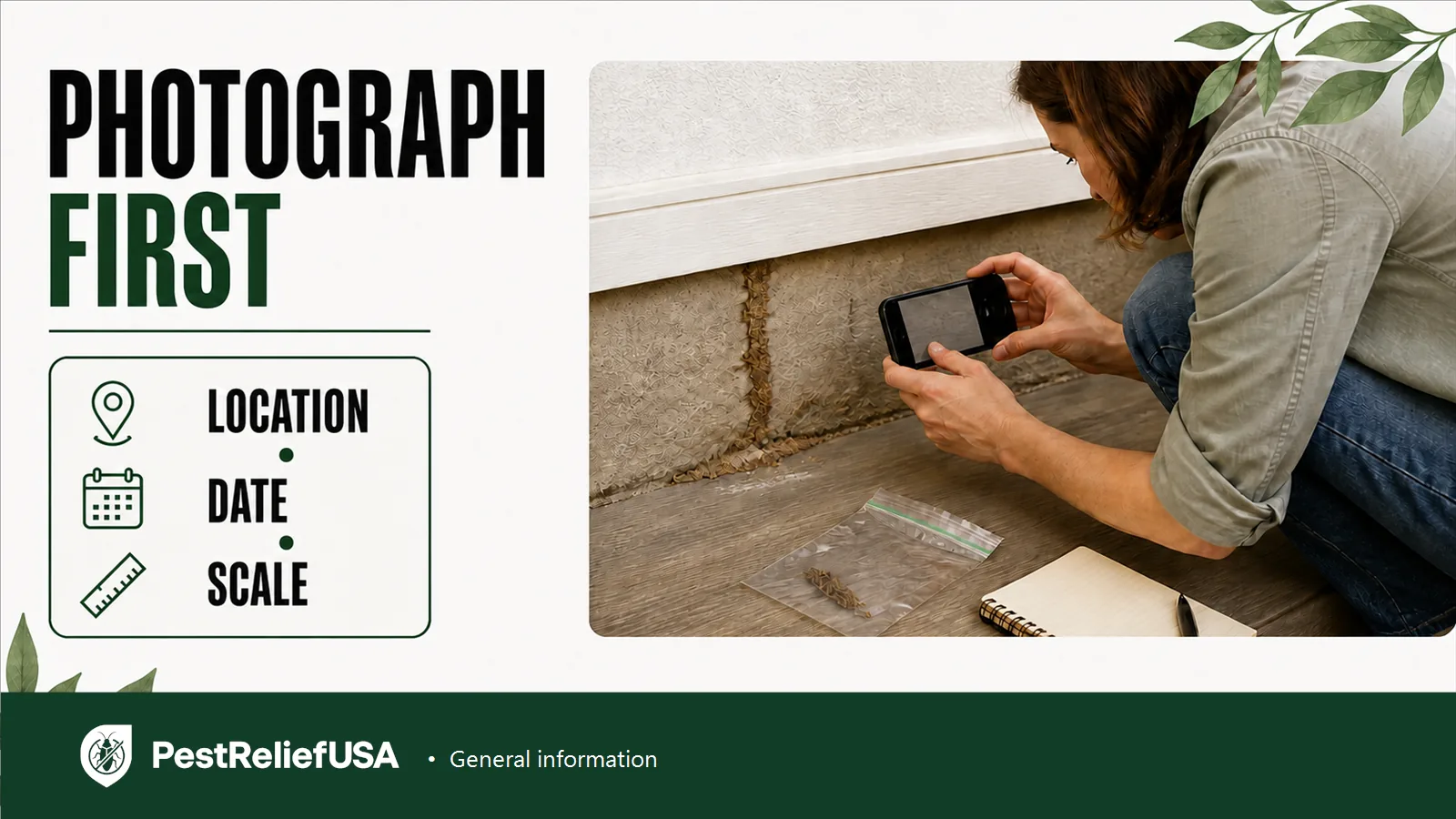
What to Photograph and Record Before an Inspection
Create a clear record without damaging the area. The goal is to preserve context for the independent provider who evaluates the property.
- Take a wide photo first. Show the room, wall, foundation section, or building feature where the clue appears.
- Add close views. Use good light and include a ruler, coin, or other familiar object for scale without moving the evidence.
- Record the place and date. Note the room, surface, height, indoor or outdoor location, and when you first noticed it.
- Describe changes over time. Record whether a pile returned after ordinary cleaning or whether a surface change progressed, but do not disturb an area to test it.
- Retain only loose material when practical. A loose insect, wing, or pellet can be placed in a sealed container. Do not break a tube or cut into wood to obtain a sample.
- Note nearby conditions. Photograph visible moisture staining, leaks, drainage issues, or wood-to-soil contact as context, not as proof.
- Leave treatments and invasive checks to the provider. Avoid spraying the area, applying a pesticide, opening finishes, or probing structural materials before the assessment.
The guide to what to expect during a termite inspection explains how accessible areas and reported evidence may fit into an inspection. The independent provider determines identification, findings, inspection scope, and any property-specific recommendations.
Frequently Asked Questions
What are the most common signs of termites?
Possible signs include mud or shelter tubes, indoor swarmers, discarded equal-length wings, hollow or tunneled wood, soil-like material in galleries, and drywood termite pellets. Surface changes can add context but have many non-termite causes. One sign alone cannot confirm the type, activity status, extent, or structural impact.
What do termite damage signs look like inside wood?
Subterranean termite damage may follow the wood grain and contain soil or mud-like material in galleries. Drywood termite galleries and pellets look different because drywood termites live in wood without a soil connection. Do not cut open finished or structural wood to compare patterns; document only what is already accessible.
How can I tell whether termite evidence is active or old?
You usually cannot determine activity status from one visual clue. Tubes and damage can remain after earlier activity, and drywood pellets may persist or reappear for different reasons. Record dates, locations, and changes, then let an independent provider assess the accessible evidence and property context.
Can termite damage be mistaken for water damage?
Yes. Moisture can soften, discolor, swell, or distort wood, creating changes that overlap with possible termite evidence. Both conditions can also occur together. Photograph the wood and nearby moisture sources, but avoid assigning a cause until the property has been assessed.
Is one termite swarmer inside a house enough to confirm an infestation?
No. One suspected swarmer is worth photographing and retaining if practical, but it does not confirm an infestation, termite type, colony location, or need for treatment. Identification depends on the insect’s features and the surrounding evidence, ideally reviewed by a qualified local professional.
A Practical Next Step
Preserve what you found: photograph it in place, record the date and location, and avoid spraying, breaking tubes, or opening building materials. For general information about possible service pathways, review the termite control information page. If you want to share property details and explore available options, use the PestReliefUSA Get Help form.
PestReliefUSA does not perform inspections or treatments and does not determine availability, identification, findings, scope, treatment, scheduling, pricing, follow-up, warranty, or contract terms. Those decisions belong to independent providers based on their own assessment.