
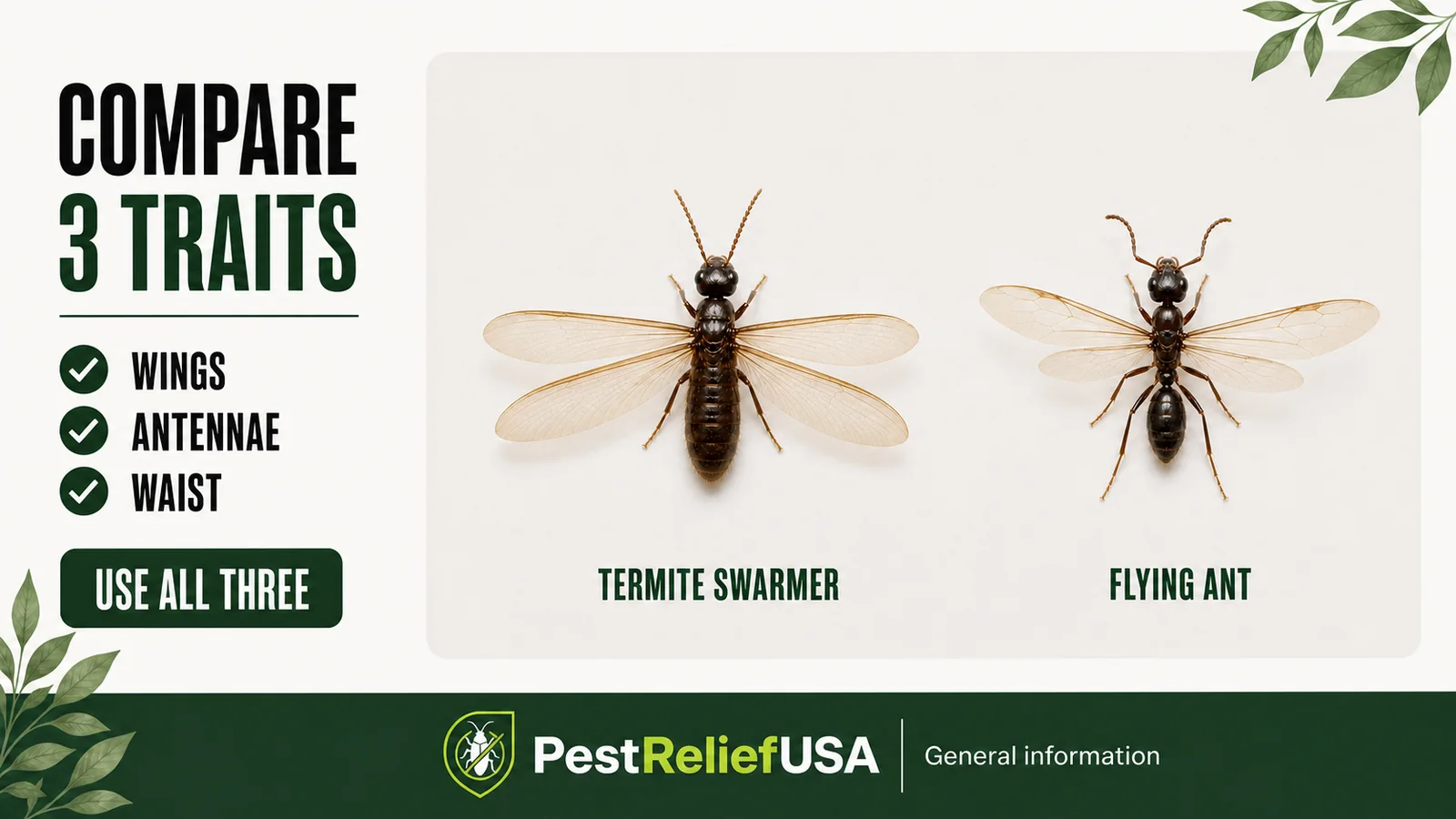
To compare termites vs. flying ants, check three features together: wing proportions, antennae, and waist shape. Termite swarmers generally have four roughly equal wings, relatively straight, beaded antennae, and a broad waist. Flying ants generally have larger front wings than hind wings, elbowed antennae, and a pinched waist.
These are identification clues, not proof that your home has an infestation. A blurry photo, an insect’s color, or a few wings near a window cannot establish the species, where a colony is located, or whether the building needs treatment.
If the features are unclear, document what you found and ask a qualified identification resource about next steps. This guide focuses on comparing winged insects; it does not replace specimen identification or a property assessment.
Termites vs. flying ants at a glance
- Wings: Termite swarmers have two pairs of approximately equal size. Flying ants have a front pair that is longer than the rear pair.
- Antennae: Termite antennae look relatively straight and beaded; ant antennae have a distinct elbow.
- Waist: A termite’s body lacks the conspicuous narrowing seen between an ant’s middle section and abdomen.
The U.S. EPA’s termite identification guidance describes the wing and antenna differences. Use the combination of visible features rather than selecting whichever single detail seems to match.
The insects discussed here are winged reproductive forms, often called swarmers or alates. This comparison does not mean every ant or termite has wings. A wingless insect needs a different identification approach; do not rule termites in or out solely because wings are absent.
Three visual differences to check
Start with an intact insect visible through a closed, clear container, or with sharp photographs. You do not need to hold it, spread its wings, or bend its antennae. If a feature is hidden, record it as unclear instead of filling in the missing detail.
Wings — roughly equal versus unequal pairs
Compare the front and rear wings on the same insect. With a termite swarmer, the two pairs are approximately equal in length. On a flying ant, the front wings are longer than the rear wings. The useful comparison is between pairs, not simply whether the wings extend beyond the body.
That distinction can be difficult to see when wings overlap. A single top-down photograph may show only the upper pair. Try a second photograph from another angle without opening the container or manipulating the insect. If you still cannot see both pairs, do not treat the apparent wing count or length as conclusive.
Termite wings detach easily, as University of Minnesota Extension’s ant identification guide explains. Shed wings can therefore be worth documenting. However, loose wings may be broken or come from several insects. A pile of similarly sized wings is not the same as comparing both pairs attached to one specimen.
Antennae — straight/beaded versus elbowed
Look at the feelers extending from the insect’s head. Termite antennae are relatively straight, with a bead-like appearance. Flying ants have elbowed antennae. The word “relatively” matters: a termite’s antenna can curve or droop without showing the characteristic ant elbow.
Do not expect to resolve this feature in every phone photo. Reflections on the container, movement, or an antenna crossing a leg can make the shape ambiguous. Focus on the head, retain the original image, and let an identification resource know if that part of the insect was not visible.
Waist and body shape — broad/uniform versus pinched
Next, look at the connection between the middle of the body and the abdomen. An ant has a visibly narrowed waist; a termite does not have that pronounced constriction. Minnesota Extension includes this body-shape distinction alongside the wing and antenna comparison.
Wings can cover the waist, so a clear side or slightly angled view may help. Do not count a shadow or a wing edge as a body segment. If the wings suggest one insect but the waist seems to suggest another, that is a reason to seek identification, not to decide by majority vote.
Why color, size, and one blurry photo can mislead
“Small and dark” is a description, not an identification. Minnesota Extension notes that ant color and size alone are insufficient for identifying ants. Avoid turning either characteristic into a shortcut for deciding whether an unknown winged insect is a termite or an ant.
Lighting can also change what a photograph appears to show. A dark insect against a bright window may become a silhouette, while glare can hide antennae or make two overlapping wings look like one. Enlarging a blurry image does not recover anatomical details that were never captured.
For a useful photo set, prioritize a focused view of the whole insect and a second view that shows the head and waist. Include a separate wider photograph of the finding location. These images answer different questions: close-ups help with identification, while the wider view preserves context.
A comparison image in an article is an educational reference, not a test result for your home. Matching its general appearance cannot establish species, colony location, or structural damage. It is reasonable to leave the identification unresolved until someone can examine better evidence.
Where the swarm appeared and why context matters
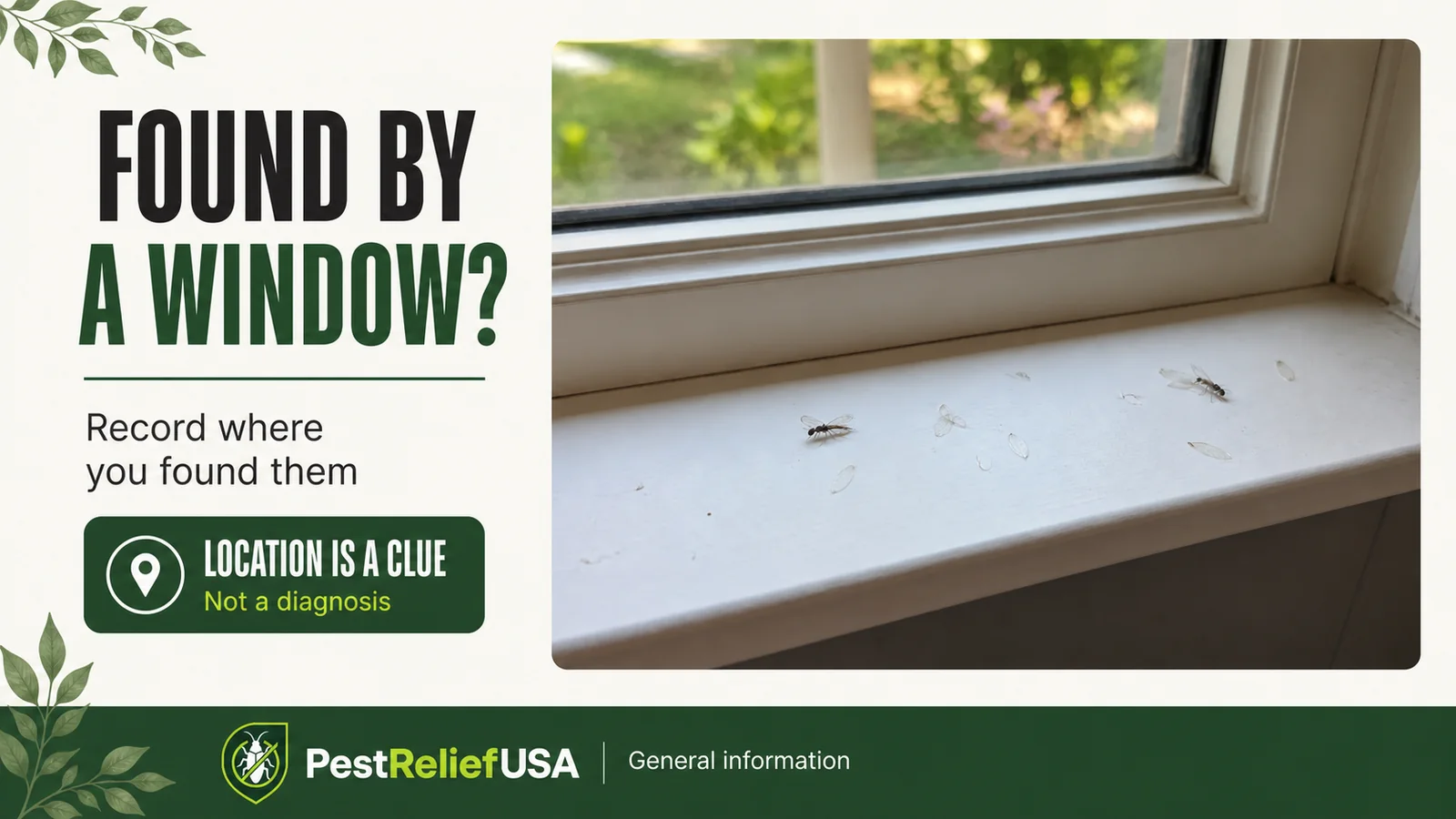
Record where you found the insects, but distinguish their resting place from an observed emergence point. “Several insects on the kitchen sill” and “insects coming out of a gap beside the kitchen window” are different observations. Do not turn the first into the second unless you actually saw it happen.
NC State Extension’s Eastern subterranean termite guide distinguishes outdoor swarming from swarming inside a structure. Its discussion concerns Eastern subterranean termites in a North Carolina context. An outdoor swarm near a tree or stump does not by itself show that the house is infested; suspected termite emergence indoors warrants identification and an appropriate property assessment.
Likewise, insects collected near an indoor window do not reveal their route into the room. Note whether a window or door was open and whether you observed emergence, but do not assume either an outdoor origin or a colony inside the wall. Leave the original observation clear for the person reviewing it.
Swarm timing varies with species, geography, weather, and local conditions. NC State’s seasonal observations should not be converted into one nationwide month range. A finding outside a familiar “termite season” still deserves the same careful comparison.
If you have additional observations beyond winged insects, use our guide to broader termite warning signs and damage. Keeping those observations separate helps you describe the property without treating every mark or insect as confirmation of one problem.
What to document before seeking identification
A short, organized record is more helpful than an unsupported label such as “definitely termites.” You can prepare the following without disturbing the building:
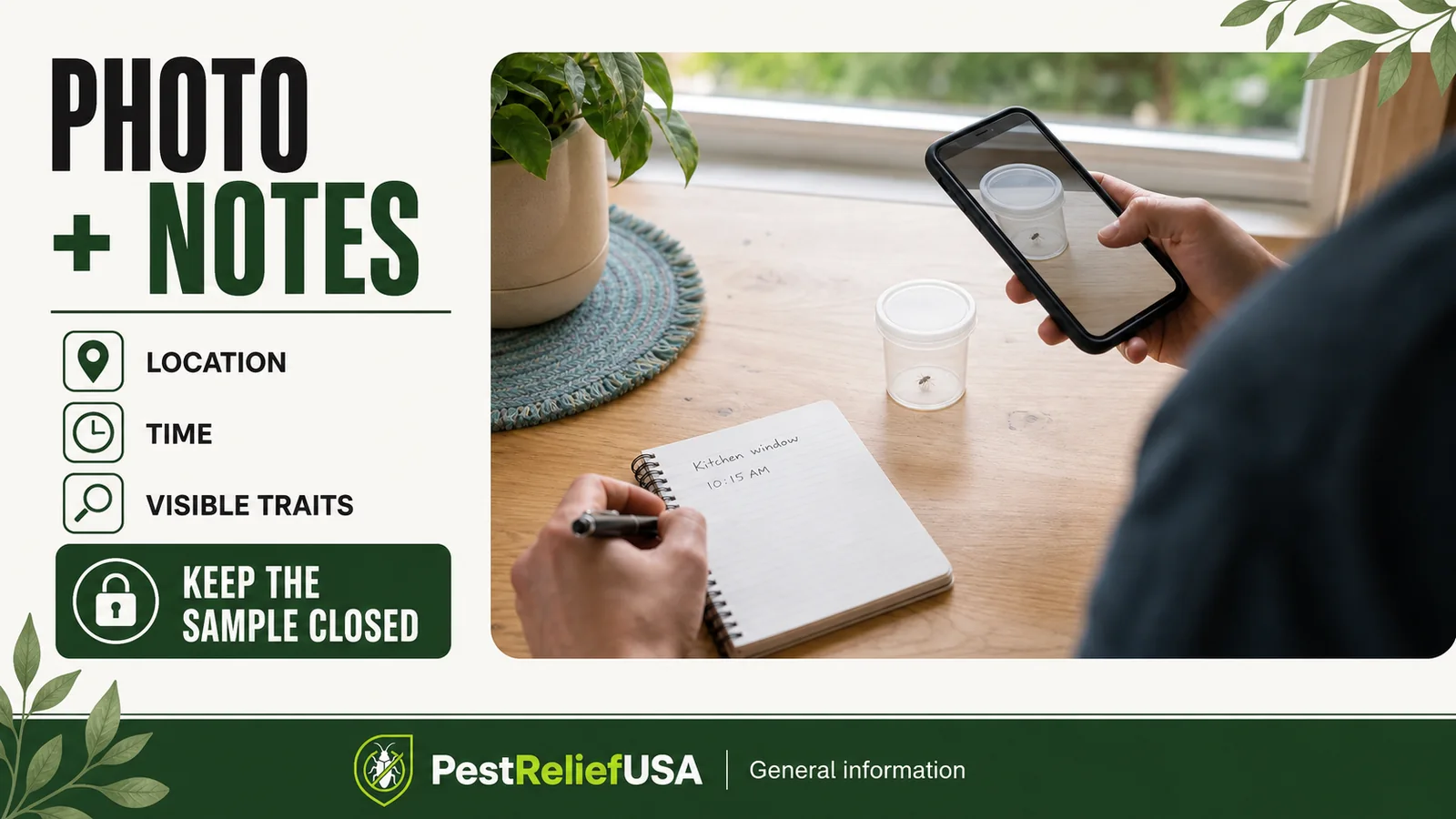
- Photograph the location. Take a wider view showing the window, doorway, or outdoor area where the insects appeared. Add a closer view of the finding.
- Photograph visible features. Try to show wings, antennae, and waist clearly. Keep unedited originals alongside any cropped copies, and note which features you could not see.
- Record the date, time, and place. Include the room or outside location, approximate number of insects, whether wings were attached or loose, and whether the finding has repeated.
- Separate observation from interpretation. Write “found on sill” unless you actually saw insects emerging. Record any observed opening without probing, sealing, or enlarging it to investigate.
- Retain a sample only if practical and safe. An already accessible insect or shed wings may be kept in a closed, clear container without direct handling. Keep it away from children and pets, and ask the receiving resource about storage or submission requirements.
NC State Extension’s swarmer guidance recommends retaining insects or wings for identification. Its named Extension services are local to North Carolina. Elsewhere, contact your local Extension office, a qualified identification resource, or an independent pest provider to ask whether they accept photographs or specimens before sending or delivering anything.
If collecting a sample would require reaching into a gap, touching insects, or opening part of the structure, stop with photographs and notes. Ask what additional evidence would be useful. You do not need to create a perfect specimen to make an initial inquiry.
What not to do after finding winged insects
Do not spray insects as an identification step, open walls, pry at wood, or break suspected mud tubes. These actions are not necessary to compare visible traits. Preserve what you can document and ask about an assessment if the finding remains concerning.
Do not assume that removing visible swarmers resolves possible termite activity. NC State’s swarmer guidance explains that killing the visible insects does not protect against colony activity that may already be present. Conversely, seeing insects alone does not tell you which treatment, if any, is appropriate.
Avoid booking a specific treatment on the strength of a photo match. If an independent provider recommends an inspection, ask what areas are accessible, what the assessment includes, and what limitations will be recorded. Our termite inspection guide explains questions to prepare; it does not promise that every provider offers the same scope.
Frequently asked questions
Can a phone photo confirm flying ants or termites?
A clear photo may help someone assess visible traits, but it may not show enough detail for a reliable identification. Supply several views and the finding location, and ask whether a specimen is needed. Even a correct insect identification does not establish the condition of the building.
Are discarded wings enough to identify termites?
Not by themselves. Photograph the wings where you found them and retain an accessible sample if safe. Wings without an intact insect may not show their original arrangement, and a photograph may hide damage or overlap. Describe them as discarded wings until identification is supported.
Does an outdoor swarm mean I need termite treatment?
No treatment decision follows automatically from an outdoor swarm. Document the location and seek identification if uncertain, especially if you also observe insects emerging from the building. An independent provider can explain whether a property assessment is appropriate and what findings would support a recommendation.
If they are flying ants, can I dismiss the finding?
Identifying ants changes the question; it does not answer every question about the property. Minnesota Extension notes that carpenter ants can damage wood through nesting activity. Do not assume all flying ants are carpenter ants. Ask what further identification or assessment, if any, is warranted.
Does home maintenance replace identification?
No. Our termite prevention tips cover maintenance that addresses conducive conditions. Those steps do not identify an insect or guarantee that swarmers will never appear. Keep the identification inquiry separate from routine maintenance and any later provider recommendations.
A practical next step
Compare wings, antennae, and waist together; preserve clear observations; and seek help when the features or location remain uncertain. You can review our termite-control information or share property details to explore available next steps.
PestReliefUSA is an independent information and referral resource, not an inspection or treatment provider. Independent providers determine availability, identification, findings, recommendations, scope, treatment, scheduling, pricing, follow-up, warranties, and contract terms. Confirm those details directly with the provider before agreeing to any work.