The three termite names homeowners hear most often do not describe three equal categories. Subterranean termites are a broad group that usually nests in soil and reaches wood through the ground or shelter tubes. Drywood termites establish colonies inside dry, sound wood without routine soil contact. The Formosan subterranean termite is an invasive subterranean species with traits that can change what an inspector looks for and how a provider evaluates the structure.
Among the major types of termites in the US, native subterranean termites are the most widespread. Drywood and Formosan termites are more regionally concentrated. Location, nesting behavior, moisture, construction, and the evidence present all matter; one sign alone may not establish the type.
PestReliefUSA is an independent information and referral resource. We do not inspect properties, identify termites, select treatments, set prices, schedule service, or guarantee outcomes. An appropriately licensed independent provider determines findings, recommendations, scope, timing, follow-up, warranty, and contract terms.
Types of termites in the US: subterranean, drywood, and Formosan at a glance
| Comparison point | Native subterranean termites | Drywood termites | Formosan subterranean termites |
|---|---|---|---|
| Relationship | A broad group; common U.S. structural pests include native Reticulitermes species | A separate group adapted to living within relatively dry wood | An invasive subterranean species, Coptotermes formosanus |
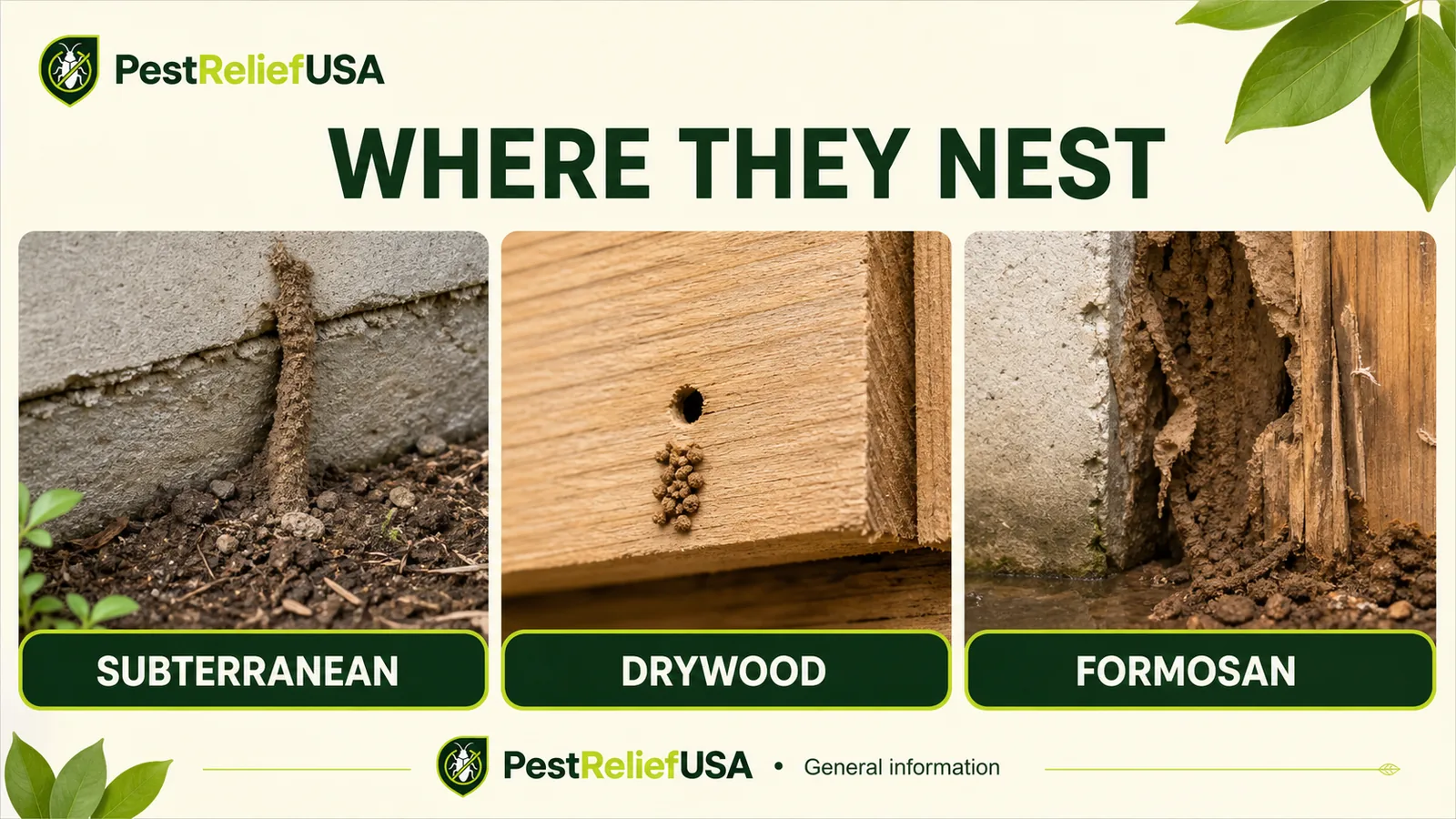
| Typical nest setting | Usually in soil, with workers traveling to wood | Entire colonies can live inside wood above ground | Usually soil-associated, but a moisture-supported carton nest can sometimes occur above ground |
| Common structural clues | Shelter tubes, soil-associated entry, damaged wood, swarmers or shed wings | Hard, ridged fecal pellets, small kick-out holes, damaged wood, swarmers or shed wings | Shelter tubes and other subterranean signs; soldiers and carton material can aid professional identification |
| U.S. distribution | Widespread, although the species present vary by region | More important in warm coastal, southern, and southwestern areas; infested wood can be moved | Established in parts of the southern United States and Hawaii; distribution is patchy and should be checked locally |
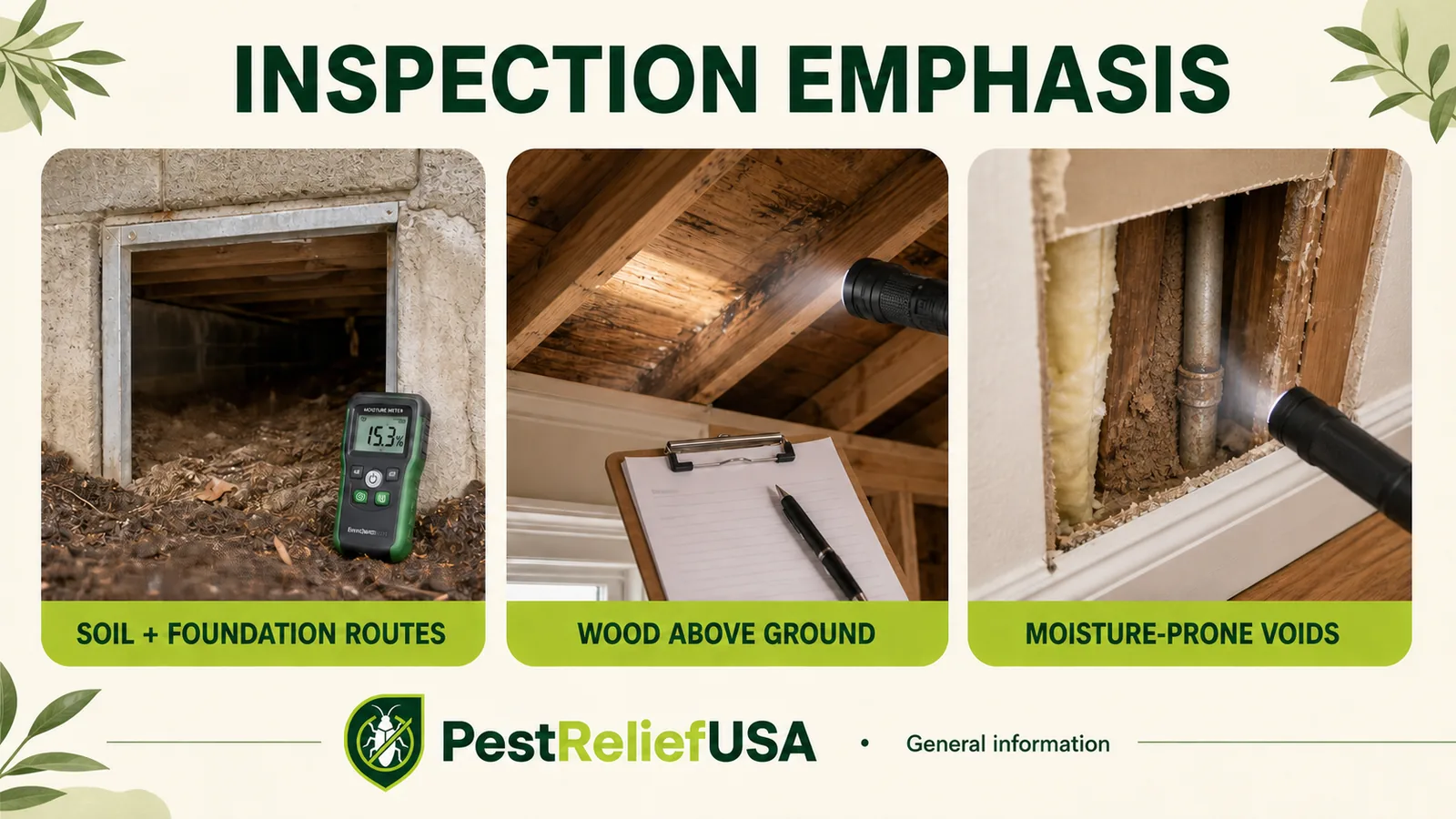
| Inspection emphasis | Soil-to-wood pathways, foundation areas, moisture, tubes, crawlspaces, and accessible wood | Accessible wood throughout the structure, pellets, kick-out holes, wings, and the possible extent of hidden colonies | Subterranean entry points plus moisture-prone areas and possible aboveground carton material |
This table is an orientation tool, not a diagnosis. Termite species, flight seasons, and established ranges differ across the country. A state Cooperative Extension service or pesticide regulatory agency can provide current local context.
What “subterranean,” “drywood,” and “Formosan” actually mean
Subterranean termites: a soil-associated group
Subterranean termites live in organized colonies with workers, soldiers, and reproductives. Their name reflects their usual association with soil, which supplies the moisture their colonies need. Workers can move from a nest to wood through soil, cracks, concealed routes, or constructed shelter tubes.
The U.S. Environmental Protection Agency identifies native subterranean termites as the most common type across most of the country. That national statement does not mean the same species, pressure, or swarming season applies everywhere. For example, University of Georgia Extension discusses Reticulitermes biology in the eastern United States, so its seasonal examples should not be treated as a nationwide calendar.
A subterranean colony is not necessarily beneath the damaged board a homeowner notices. Foraging paths may extend through concealed areas, so an inspection considers the building and site rather than only the most visible spot.
Drywood termites: colonies contained within wood
Drywood termites can establish a colony inside dry, sound wood without a continuing connection to soil. They may occupy structural lumber, trim, doors, furniture, fences, or other suitable wood. Because the colony can remain hidden within a piece, activity may be difficult to delimit from the exterior.
University of California Statewide IPM notes that western drywood termites are important in Pacific coastal, Central Valley, and southern California areas. Other drywood species occur elsewhere, especially in warmer regions. Those California details are regional evidence, not a national range map.
Drywood colonies push firm, ridged fecal pellets through small openings in wood. Pellets can support an identification, but UC IPM cautions that they do not reveal whether activity is current or how far a colony extends.
Formosan termites: a particular subterranean species
The Formosan subterranean termite is not a third nesting category separate from subterranean termites. It is an invasive species within the subterranean group. Homeowners may see it listed separately because its distribution, colony organization, soldiers, swarming behavior, and capacity to form carton nests can matter during identification and inspection.
University of Georgia Extension explains identification differences between Formosan and native subterranean termites, while emphasizing Georgia conditions. Mississippi State University Extension describes Formosan termites as established in portions of the southern United States and notes that moisture can support an aerial colony in a structure. Because distribution records evolve, homeowners should verify current county or state information rather than rely on a static national graphic.
“Formosan” should not be inferred from damage or a large swarm alone. Soldiers, winged reproductives, nest material, location, and other evidence may be needed for identification.
Where each type is found in the United States
Native subterranean termites are the broadest national concern. EPA reports them as the most common type in most of the United States, but local species differ. Climate, soil, elevation, moisture, and human movement can influence which termites are present.
Drywood termite importance is more regional. They are associated especially with warmer coastal, southern, and southwestern areas, but furniture, lumber, or other infested wooden items can move colonies beyond an expected outdoor range.
Formosan subterranean termites are established in a patchwork of warmer U.S. areas, including parts of the Southeast, Gulf Coast, and Hawaii. “Southern state” is still too broad to confirm local establishment. State Extension and agriculture resources are better suited to current county-level questions.
Distribution is a probability clue, not a standalone identification method. Ranges change, and an inspector should connect the identification to observable evidence.
Subterranean vs drywood termites: how nesting changes the clues
Soil contact and shelter tubes
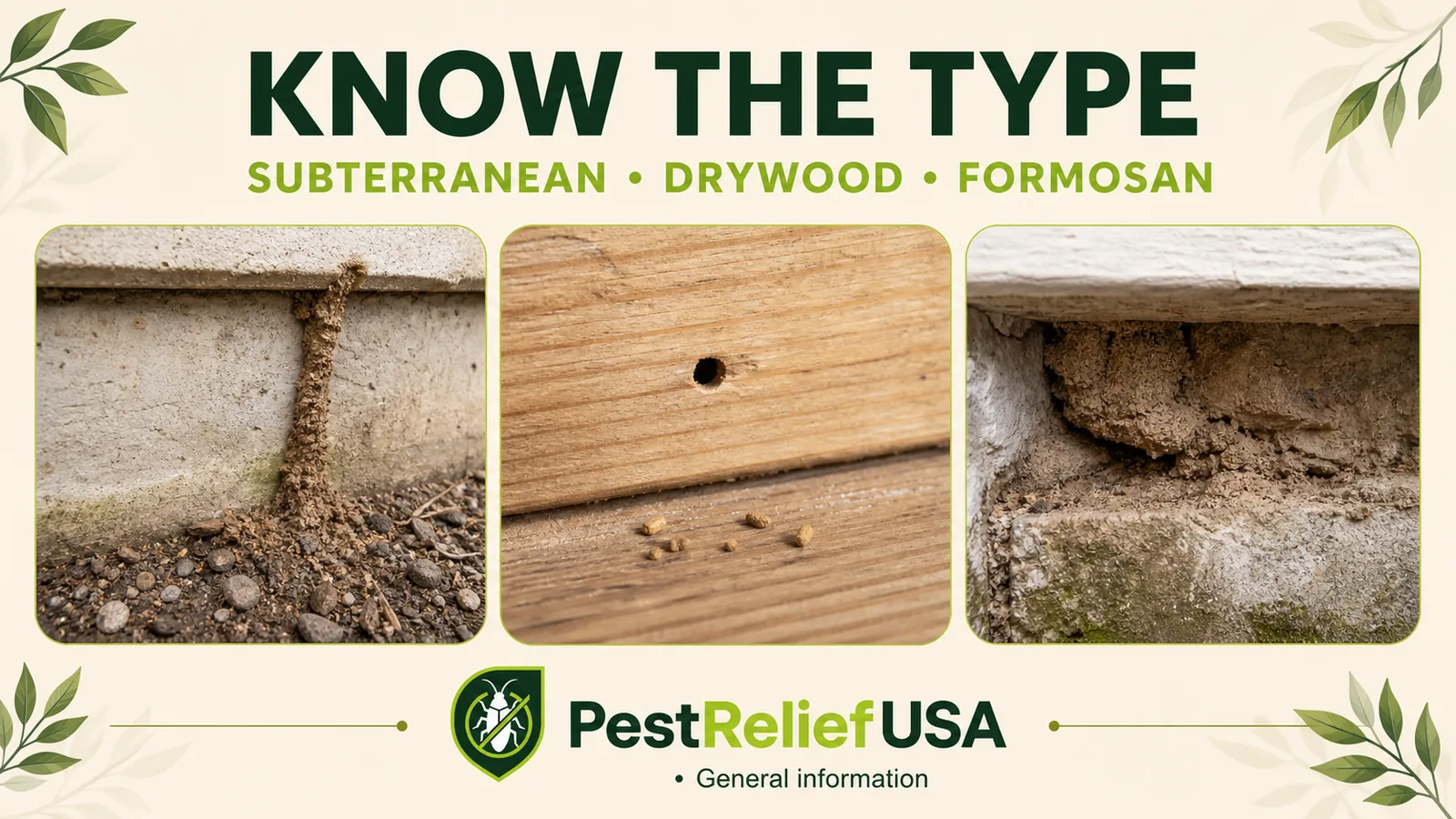
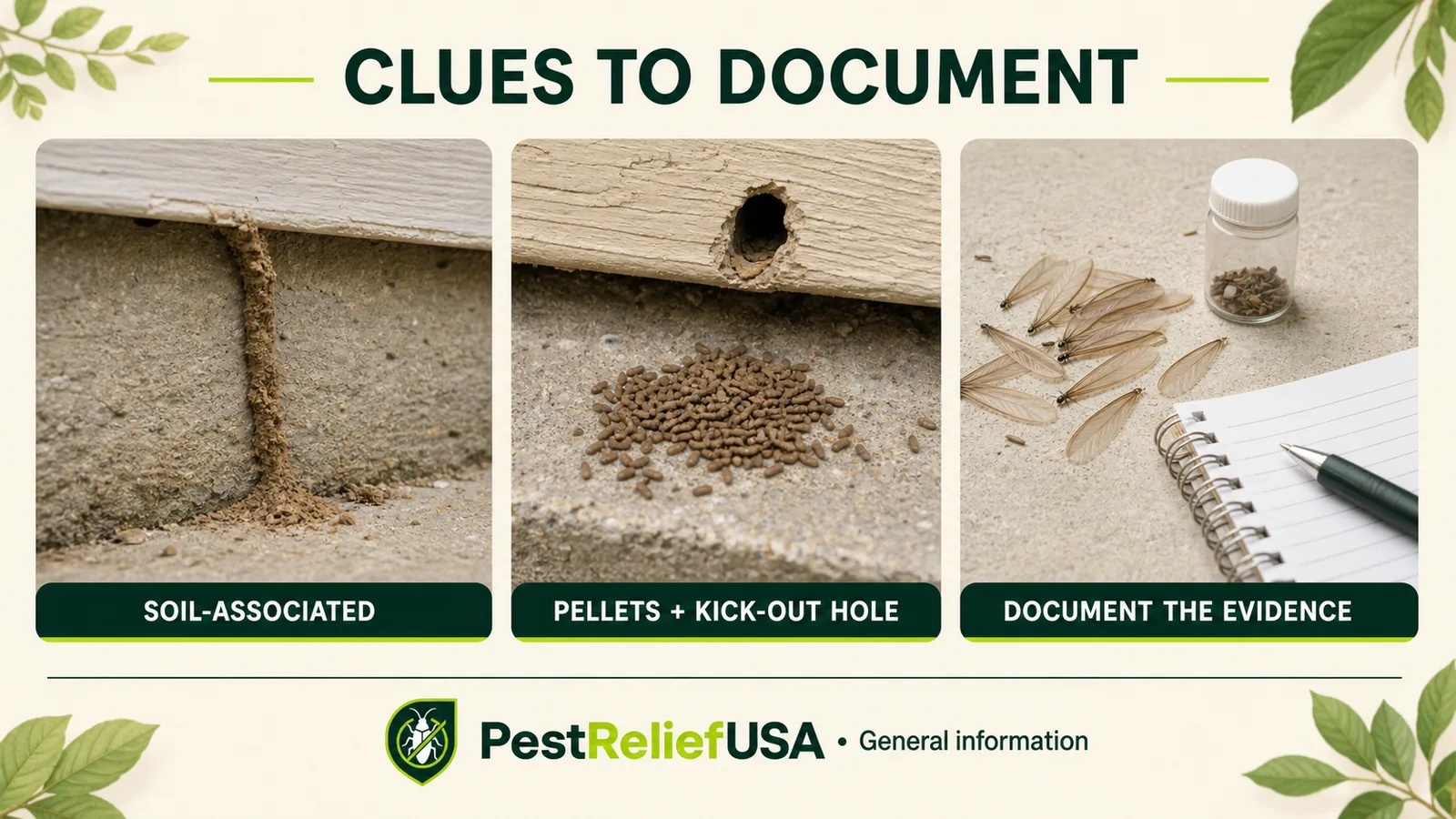
Native subterranean and Formosan termites commonly use soil-associated routes. Shelter tubes can protect workers moving across exposed masonry or other surfaces between soil and wood. Tubes may appear on a foundation, crawlspace pier, sill area, slab penetration, or another protected route.
A tube is important evidence, but its appearance alone does not distinguish native subterranean from Formosan termites or reveal the full extent of activity. Document its location for a qualified inspector.
Pellets and kick-out holes
Drywood termites dispose of hard fecal pellets through small openings, often called kick-out holes. Repeated piles beneath wood can point an inspector toward a concealed gallery. Pellets can vary in color with the wood consumed, so color is not a dependable species test.
Sawdust-like debris can also come from other insects or construction. Particle shape, nearby openings, wings, wood condition, and context all help. Our guide to signs of termite damage explains how to document clues without making a do-it-yourself diagnosis.
Carton material and aboveground moisture
Formosan colonies can build a carton-like nest material from soil, chewed wood, and waste. Although they are subterranean termites, a sufficiently moist aboveground location may support an aerial colony that is not currently dependent on direct soil contact. Chronic leaks, roof problems, plumbing issues, and trapped moisture can therefore affect the inspection scope.
Carton material is not something a homeowner should identify from description alone, and not every Formosan infestation has an accessible aerial nest. It is one possible finding that may prompt a provider to inspect moisture-prone or concealed areas more closely.
Swarmers and wings: useful, but easy to overinterpret
All three can produce winged reproductives, often called swarmers or alates. A swarm indoors, emerging insects, or a concentration of shed wings deserves attention. However, flight timing depends on species, weather, and region. A spring-versus-summer rule copied from one state can mislead homeowners elsewhere.
Body shape, antennae, wings, color, size, time, and emergence location can contribute to identification. If practical, preserve several intact insects and record where and when they appeared for an inspector or local Extension contact.
Identifying a termite type is different from distinguishing termites from ants. Our visual guide to termites vs. flying ants compares antennae, wings, and body shape to help you document an unfamiliar winged insect.
Why inspection implications differ
A professional inspection begins with evidence, accessible areas, construction, moisture, and local termite likelihood. The suspected type changes where the inspector may concentrate attention, but no general article defines the scope of a specific inspection.
- For native subterranean termites, relevant areas may include foundations, slab penetrations, crawlspaces, soil-to-wood contact, shelter tubes, moisture sources, and accessible damaged wood.
- For drywood termites, the search may extend through accessible wood above ground for pellets, kick-out holes, wings, galleries, and separated areas that could contain more than one small colony.
- For Formosan termites, the inspection may combine subterranean entry review with closer attention to moisture-prone voids and possible carton material. Species confirmation may require suitable specimens.
Accessibility limits matter. Finished walls, roofs, attached structures, stored belongings, insulation, decks, and other features can conceal evidence. Ask what areas were accessible, obstructed, excluded, or recommended for further evaluation. Our termite inspection guide outlines questions to ask before, during, and after an inspection.
Why treatment implications differ
The termite type can change which treatment categories a provider discusses because the colony is located and connected to the structure differently. Subterranean approaches are generally designed around soil-associated foraging and structural entry. Drywood evaluation may focus on accessible localized areas or the extent of colonies contained within the structure. Formosan findings may require the provider to account for both subterranean pathways and any moisture-supported aboveground nest evidence.
This article does not recommend a product or method. A licensed provider considers the confirmed type, findings, construction, access, moisture, label, state rules, and agreement. EPA advises homeowners to verify licensing and review the proposed pesticide label.
If a proposal discusses soil treatment or baiting for a subterranean termite finding, ask how the method addresses the documented entry routes and nesting conditions. A general comparison cannot select a method without property-specific findings.
Be cautious with claims that a treatment name alone proves complete coverage or a guaranteed result. The written scope, exclusions, follow-up, renewal, and warranty or contract language control what an independent provider offers.
What homeowners can do before an inspection
- Record the evidence. Photograph tubes, pellets, wings, damaged wood, or moisture conditions in context before cleaning or repairs.
- Save specimens when practical. Several intact insects are more useful than a blurred image. Avoid handling pesticides or disturbing concealed areas to collect them.
- Note the location and time. Record the room, building side, floor, nearby window or light, weather, and approximate time of emergence.
- Identify access limits. Tell the inspector about locked areas, crawlspace access, additions, prior repairs, leaks, and known past termite work.
- Gather records. Previous inspection reports, contracts, treatment diagrams, product records, warranties, and repair invoices may add context.
- Avoid self-diagnosis from one clue. Distribution maps, swarm season, pellet color, or damage amount are not sufficient by themselves.
Separately, correcting leaks and reducing avoidable wood-to-soil contact can address conditions associated with termite risk, but prevention steps do not identify or resolve an existing infestation. See our practical termite prevention guide for a maintenance-focused checklist.
Questions to ask an independent provider
- Which termite type or species did you identify, and what evidence supports that finding?
- Is that termite currently established in this area, and what local source supports the range information?
- Which areas were inspected, inaccessible, obstructed, or excluded?
- Did you find soil-to-wood routes, shelter tubes, pellets, kick-out holes, swarmers, wings, carton material, or moisture concerns?
- Does the proposed scope address the identified nesting behavior and all documented areas?
- What product label, state licensing requirements, and site constraints apply?
- What follow-up, renewal, retreatment, exclusions, warranty, and contract terms are written into the proposal?
Frequently asked questions
Are Formosan termites the same as subterranean termites?
Formosan termites are a species of subterranean termite. The name is often discussed separately because identification traits, distribution, colony behavior, and possible carton nests can affect an inspection.
What is the simplest difference between subterranean and drywood termites?
Subterranean termites are generally associated with soil and often use shelter tubes to reach structural wood. Drywood termites can keep an entire colony inside dry wood without routine soil contact and often expel hard fecal pellets.
Can pellets tell me that drywood termites are active?
Pellets are an important drywood clue, but pellets alone do not establish current activity or show the full extent of a colony. An inspector may consider their shape, location, recurrence, openings, wings, damage, and other evidence.
Can a home have more than one termite type?
It is possible for different termite groups or colonies to affect a property or its contents. Each finding should be documented and identified rather than assuming one explanation covers every area.
Does the termite type determine the treatment automatically?
No. Type is important, but the provider also considers inspection findings, construction, access, moisture, product labels, applicable rules, and the written service scope. PestReliefUSA does not select a treatment.
Bottom line
For U.S. homeowners, the most useful distinction is where the colony lives and how it reaches wood. Native subterranean termites are widespread and usually soil-associated. Drywood termites live within wood and often leave characteristic pellets. Formosan termites are an invasive subterranean species that may add identification and moisture-related inspection considerations.
Use distribution and visible clues to document evidence—not to make a final diagnosis.
Sources and regional context
- U.S. EPA: Termites—How to Identify and Control Them — national overview and pesticide/licensing context.
- UC Statewide IPM: Drywood Termites — peer-reviewed drywood biology and detection guidance, with California-specific distribution.
- University of Georgia Extension: Biology of Subterranean Termites in the Eastern United States — eastern U.S. biology and regional examples.
- University of Georgia Extension: Identifying the Formosan Subterranean Termite — regional identification comparison.
- Mississippi State University Extension: Protect Your House from Termites — southern U.S. comparison and Formosan aerial-colony context.
Contact PestReliefUSA
Questions about this guide or the referral process can be sent to [email protected]. For property-specific assistance, use the Get Help form. Neither channel provides an inspection, diagnosis, quote, scheduling confirmation, or emergency service; independent providers control availability, findings, recommendations, scope, pricing, follow-up, warranties, and terms.