
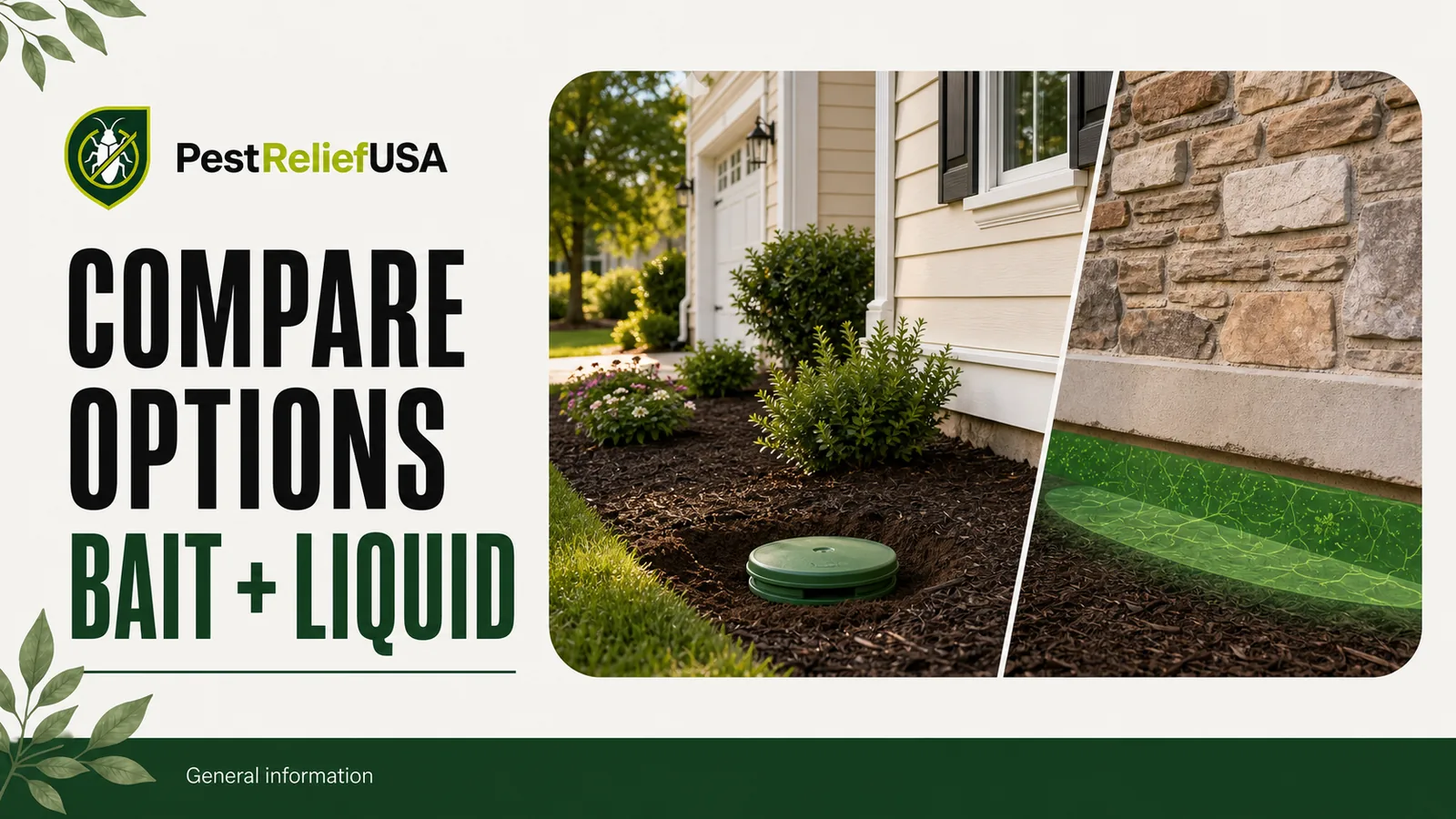
When comparing termite bait stations vs liquid treatment, the core difference is how each approach reaches subterranean termites. Bait stations depend on foraging termites finding and feeding at monitored stations. Liquid termiticides create a treated soil zone that termites encounter around or beneath a structure. Neither option is universally better, and neither guarantees a particular result.
An appropriately licensed independent provider may discuss one method or a combination after considering the termite type, inspection findings, construction, access, nearby wells or drains, product-label requirements, and state or local rules. This comparison helps homeowners read a proposal and ask better questions; it does not select a treatment for a property. Homeowners sometimes describe this as a termite bait system vs liquid barrier choice, but the written scope matters more than the shorthand.
PestReliefUSA is an independent information and referral resource. We do not inspect properties, identify termites, apply pesticides, select treatments, set prices, or promise provider availability.
Termite bait stations vs. liquid treatment at a glance
- Mechanism: Baits use slow-acting active ingredients in cellulose material; liquid treatments place a registered termiticide in soil where termites may encounter it.
- Installation: In-ground stations usually require limited surface disturbance. Liquid work may involve trenching, drilling, or both, depending on construction and the label.
- Timing: Bait performance depends on termites finding and consuming the bait. A liquid-treated zone is established during application, but that does not mean all termite activity ends immediately.
- Monitoring: Bait programs rely on station inspection and maintenance. Follow-up for liquid treatment depends on the proposal, findings, product, and contract.
- Site constraints: Wells, cisterns, drains, slabs, hardscaping, and access can shape what a provider is permitted or able to propose.
- Contract: Visit frequency, renewal, retreatment, cancellation, and any damage-related terms vary. Read the written agreement rather than assuming standard coverage.
How each approach works
Termite bait stations
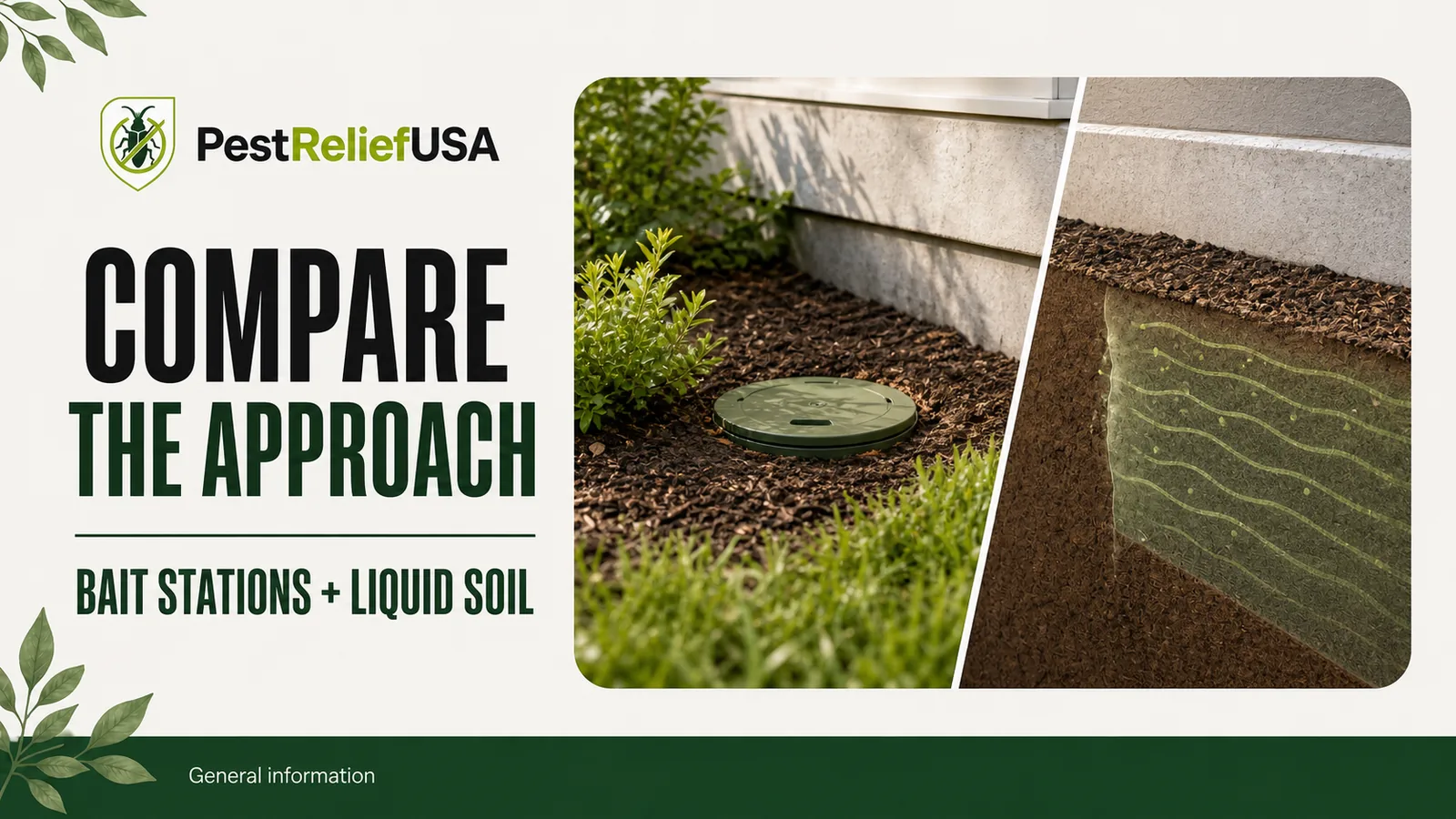
Professional bait systems commonly use stations placed in soil around a structure. Depending on the system, a station may contain monitoring material, bait, or both. The U.S. EPA describes termite baits as cellulose material containing a slow-acting insecticide.
The approach depends on worker termites encountering and feeding on the material during normal foraging. NC State Extension explains that current bait systems do not attract termites from a distance and that there is no universal timetable for termites to find a station. Its detailed examples reflect North Carolina conditions; product availability, rules, placement, and service schedules can differ elsewhere.
Baiting is therefore a monitored program rather than a one-time placement. The written proposal should explain who owns the stations, how they will be checked and maintained, what activity triggers a response, and what happens if the agreement ends. Do not assume a visit schedule from a general article; the product label and provider contract govern the actual program.
Soil-applied liquid termiticide treatment
A liquid treatment places a termiticide in soil around and, where called for, beneath parts of the structure. “Liquid barrier” is common shorthand, but the exact mechanism depends on the registered product. EPA identifies liquid soil-applied termiticides as one approved treatment category and states that products used as barrier treatments must be labeled for that use.
The application can require access to soil beside or beneath foundations, slabs, porches, patios, masonry, or other construction features. That may mean trenching, drilling, or another label-directed method. The actual scope cannot be inferred from the house footprint alone.
EPA warns that an improperly conducted soil treatment can contaminate a home or nearby drinking-water wells and fail to protect against termites. It recommends using a licensed, trained pest-management professional and following the product label. This is a reason to ask how site features affect the proposal, not an invitation to reproduce professional application steps.
Seven differences homeowners should compare
1. Goal and mechanism
Baits work through termite foraging and feeding. Liquid treatments establish a treated soil zone. Both are recognized approaches for subterranean termite management, but they do not operate on the same pathway or timetable.
A proposal should connect the recommended method to documented findings. Ask what termite type was identified, what evidence supports that identification, and which property conditions matter. Our termite inspection guide explains what a written inspection may cover without promising a uniform inspection scope.
2. Installation and property access
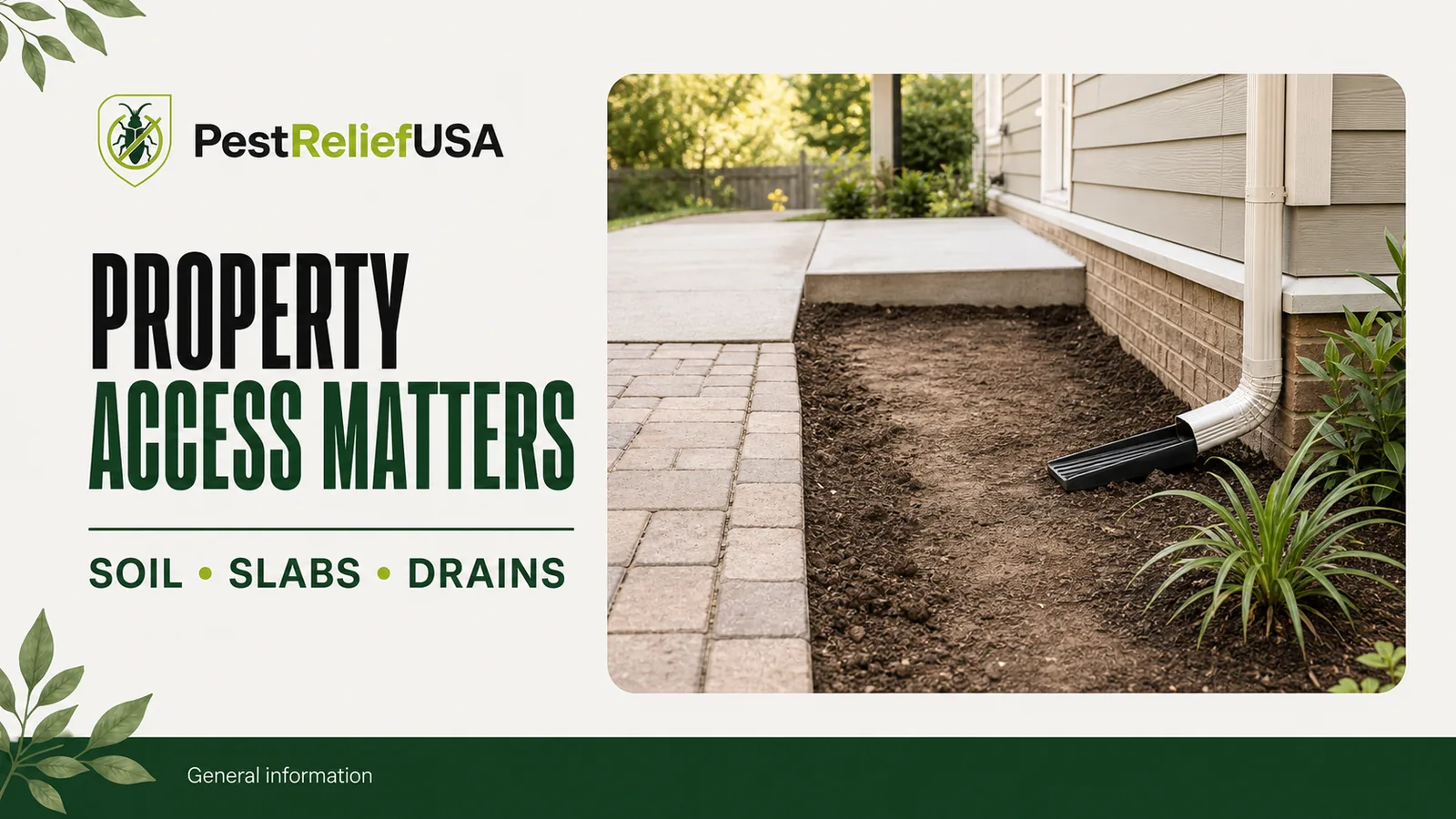
Bait stations are generally installed in accessible soil at intervals determined by the system and label. Liquid treatment may require reaching soil along foundations and beneath hard surfaces. Construction type, finished areas, patios, walkways, crawlspaces, basements, and perimeter access can all change the proposed scope.
NC State notes that extensive slab or masonry drilling can make liquid treatment more difficult in some situations. That observation comes from a North Carolina Extension resource and is not a nationwide installation rule. Ask the provider to mark the areas included, excluded, drilled, trenched, monitored, or otherwise addressed.
3. Disruption and preparation
Bait installation usually causes less initial surface disruption than trenching or drilling. Liquid work can require clearing exterior access or moving items from a treatment area. Reentry or occupancy instructions vary by product and must come from the label and applicator; EPA specifically advises homeowners to ask when they may reenter a treated residence.
Recurring station access is part of many bait programs. Before agreeing, ask what gates, landscaping, pets, locked areas, or other access conditions the service visits require. For either method, obtain preparation and post-service instructions in writing.
4. Time expectations
Bait stations must be found and fed on before the active ingredient can have its intended effect. NC State states that the impact is not immediate and that finding stations cannot be predicted to a universal deadline. Weather and local conditions may influence foraging, but a general guide cannot convert those variables into a completion date for a property.
A liquid-treated zone is created during application. That fact alone does not prove that every termite in or near a building is gone at once. Ask what observations, inspections, or other documented indicators the provider will use to assess progress and what the response will be if activity continues or reappears.
5. Monitoring and ongoing service
Monitoring is central to a bait program because stations need inspection and maintenance under the applicable label and service plan. The frequency may change when activity is detected. A proposal should state the schedule or explain how it is determined.
Liquid-treatment follow-up is not one universal program. Some written agreements may include inspections, callbacks, or retreatment conditions; others may define a different scope. Compare the actual documents rather than treating “liquid” as a complete description of ongoing service.
6. Wells, drains, and other site constraints
Properties with a well, cistern, foundation drain, or nearby water feature require careful review before a soil-applied treatment is selected. NC State’s guidance on wells, cisterns, and foundation drains explains why these features can limit liquid application and why baiting may be discussed in some cases. Its rules and examples are specific to North Carolina; other states and product labels may differ.
Tell the provider about known wells, drains, utility routes, additions, inaccessible voids, and construction changes before work is scheduled. The licensed applicator remains responsible for determining what the label and applicable rules allow.
7. Contract, renewal, and follow-up terms
A treatment name does not tell you what the agreement covers. Review the initial scope, inspection or monitoring frequency, renewal price, retreatment conditions, exclusions, cancellation process, station ownership, and the procedure for reporting new activity.
If a document uses “warranty,” “guarantee,” or “damage coverage,” ask for the exact definition. Retreatment coverage and repair coverage are not the same commitment. Contract terms vary by independent provider, so the termite treatment cost factors guide focuses on quote variables rather than presenting a national price promise.
Compare proposals over the same time horizon. One document may emphasize an initial installation while another separates inspection, monitoring, renewal, or later service into distinct charges. A lower first-year figure does not show what is included after that period. Ask each provider to identify optional items, required renewals, conditions that could change the scope, and whether stations or other equipment remain the provider’s property. Keep the signed proposal, product information, inspection findings, service records, and any later amendments together so the written history remains available if questions arise.
When a provider may discuss one method or a combination
NC State notes that a bait system may sometimes be used alone, considered when liquid treatment is constrained, or paired with localized liquid work. That does not establish a national preference or determine what is appropriate for a particular property.
A provider’s discussion may be shaped by confirmed termite type, the location and extent of observed activity, construction and access, sensitive site features, available registered products, the applicator’s licensing and training, and the service model offered. Ask the provider to explain that reasoning in the written proposal.
Two qualified providers may propose different scopes because they document different accessible areas, use different registered systems, or offer different follow-up terms. A difference is not automatically proof that either proposal is wrong. It is a reason to compare the supporting findings, exclusions, label constraints, and responsibilities line by line. If the inspection record is unclear, ask for clarification before comparing treatment names or totals.
If the recommendation is difficult to understand, request clarification or compare another qualified proposal. Do not attempt to bridge missing professional scope with a do-it-yourself pesticide application. Our DIY termite treatment vs. professional help guide explains the label and structural-protection boundary.
Questions to ask when comparing written proposals
- What termite type and findings support this recommendation?
- Which areas are included, excluded, inaccessible, drilled, trenched, or monitored?
- What product will be used, and may I review its EPA registration and label?
- What preparation, access, occupancy, and reentry instructions apply?
- For baiting, how are stations monitored, maintained, and handled if the contract ends?
- For liquid treatment, what follow-up is included and what happens if activity is found later?
- What do renewal, cancellation, retreatment, and any damage-related terms mean in writing?
- Is the company licensed in this state? EPA advises homeowners to ask to see the license and contact the state pesticide regulatory agency if concerned.

Frequently asked questions
Are bait stations always better for homes with wells?
No. A well, cistern, drain, or water feature is an important constraint, but it does not select a method by itself. The provider must evaluate the site, product label, and applicable rules. NC State’s examples are useful context, not a national prescription.
Is a liquid treatment faster than baiting?
A liquid-treated zone is established during application, while bait depends on termites finding and feeding at stations. Those facts do not create a universal timeline for resolving activity. Ask how the provider will assess progress and respond to later findings.
Do bait stations attract termites to the house?
NC State explains that current bait systems do not attract termites from a distance. Foraging termites must encounter the station. Ask the provider how the specific registered system is installed and monitored.
Are registered termite products risk-free?
No pesticide should be described as risk-free. EPA reviews pesticides before registration and requires registered termiticides to be used according to label directions and precautions. Ask for the label, preparation requirements, and reentry instructions for the proposed product.
Does routine maintenance replace treatment?
No. Repairing leaks, improving drainage, reducing soil-to-wood contact, and keeping wood debris away can address conducive conditions, but those steps do not resolve confirmed activity or guarantee prevention. See our termite prevention checklist for maintenance guidance.
A practical next step
Compare the findings, scope, site constraints, monitoring plan, and contract terms—not just the names “bait” and “liquid.” You can review our termite-control information and, if useful, share property details to explore next steps.
PestReliefUSA does not inspect, identify, recommend, quote, schedule, treat, or guarantee outcomes or provider availability. Independent providers determine availability, findings, recommendations, scope, products, application, timing, pricing, follow-up, warranties, and contract terms.